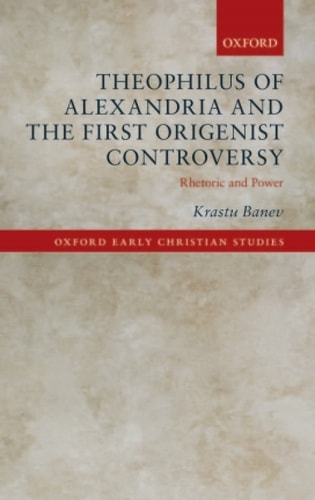
Theophilus of Alexandria and the First Origenist Controversy: Rhetoric and Power
0
0
As an Amazon Associate and affiliate partner, Menrva Books earns from qualifying purchases. Learn more
Author Description
In the age of the Theodosian dynasty and the establishment of Christianity as the only legitimate religion of the Roman Empire, few figures are more pivotal in the power politics of the Christian church than archbishop Theophilus of Alexandria (385-412). This work examines the involvement of archbishop Theophilus in the so-called First Origenist Controversy when the famed third-century Greek theologian Origen received, a century and a half after his death, a formal condemnation for heresy. Modern scholars have been successful in removing the majority of the charges which Theophilus laid on Origen as not giving a fair representation of his thought. Yet no sufficient explanation has been offered as to why what to us appears as an obvious miscarriage of justice came to be accepted, or why it was needed in the first place. Kratsu Banev offers a sustained argument for the value of a rhetorically informed methodology with which to analyse Theophilus' anti-Origenist Festal Letters. He highlights that the wide circulation and overt rhetorical composition of these letters allow for a new reading of these key documents as a form of 'mass-media' unique for its time. The discussion is built on a detailed examination of two key ingredients in the pastoral polemic of the archbishop - masterly use of late-antique rhetorical conventions, and in-depth knowledge of monastic spirituality - both of which were vital for securing the eventual acceptance of Origen's condemnation. Dr Banev's fresh approach reveals that Theophilus' campaign formed part of a consistent policy aimed at harnessing the intellectual energy of the ascetic movement to serve the wider needs of the church.
Menrva's Summary
THE THESIS
This work investigates the political and rhetorical strategies employed by Theophilus of Alexandria to orchestrate the condemnation of Origen during the late fourth century. Krastu Banev, a scholar of early Christian history, utilizes a rhetorically informed methodology to analyze the archbishop's Festal Letters. He argues that these documents functioned as a form of early mass media, designed to align the ascetic movement with the institutional goals of the church hierarchy.
THE SCOPE MAP
What You Will Find
- Analysis of the First Origenist Controversy (385-412 AD)
- Examination of Theophilus' Festal Letters as rhetorical instruments
- Study of the intersection between late-antique rhetorical conventions and monastic spirituality
- Contextualization of the Theodosian dynasty's influence on church power dynamics
Scope Limits
- The book does not provide a comprehensive biography of Origen himself
- It does not offer a theological defense or critique of Origen's original writings
THE AUTHORITY PERSPECTIVE
Scholars frequently note the academic rigor and specialized focus of this text, identifying it as a significant contribution to the study of late-antique ecclesiastical politics. Experts highlight the author's methodology as a model for analyzing polemical literature within the context of early Christian power structures.
Page Count:
256
Publication Date:
2015-01-01
Publisher:
OUP Oxford
ISBN-10:
0191040916
ISBN-13:
9780191040917
Religion
History
Biography
Christian Theology
Rhetoric
Church History
Origen
Community Tags
Similar Books