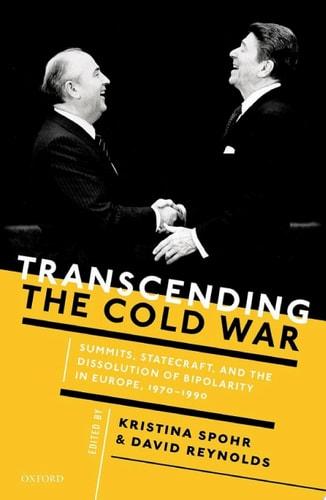
Transcending the Cold War: Summits, Statecraft, and the Dissolution of Bipolarity in Europe, 1970–1990
0
0
As an Amazon Associate and affiliate partner, Menrva Books earns from qualifying purchases. Learn more
Author Description
In 1989 and 1990 the map of Europe was redrawn without a war, unlike other great ruptures of the international order such as 1815, 1870, 1918, and 1945. How did this happen? This major multinational study, based on archives from both sides of the 'Iron Curtain', highlights the contribution of international statecraft to the peaceful dissolution of Europe's bipolar order by examining pivotal summit meetings from 1970 to 1990. These are organized into three periods: 'Thawing', 'Living with', and 'Transcending' the Cold War. The volume offers fascinating insights into key statesmen such as Richard Nixon and Ronald Reagan, Leonid Brezhnev and Mikhail Gorbachev, Willy Brandt and Helmut Kohl, Zhou Enlai and Deng Xiaoping. It explores the central issues of the superpowers and arms control, their triangular relationship with China, and the seemingly intractable German question. Particular attention is devoted to the cultural dimensions of summitry, as performative acts for the media and as encounters with 'the Other' across ideological divides. All these threads are drawn together in a sweeping analytical conclusion. Written in lively prose, Transcending the Cold War is essential reading for anyone interested not just in modern history but also current international affairs.
Menrva's Summary
THE THESIS
How did the international order of Europe undergo a peaceful dissolution between 1970 and 1990 without the catalyst of a major war? David Reynolds and Kristina Spohr, both distinguished historians of international relations, utilize a vast array of declassified archives from both sides of the Iron Curtain to reconstruct the mechanics of high-level diplomacy. Their argument posits that the transition from a bipolar world was not merely a result of structural collapse, but the product of deliberate, iterative statecraft and performative summitry that gradually eroded ideological barriers.
THE SCOPE MAP
What You Will Find
- Analysis of pivotal summit meetings between 1970 and 1990.
- A tripartite framework categorizing the era into 'Thawing', 'Living with', and 'Transcending' the Cold War.
- Examination of the triangular relationship between the United States, the Soviet Union, and China.
- Investigation into the cultural and performative dimensions of diplomatic encounters.
Scope Limits
- The study focuses primarily on the diplomatic and statecraft aspects of the dissolution rather than grassroots social movements.
- The analysis is bounded by the specific timeframe of 1970 to 1990.
THE AUTHORITY PERSPECTIVE
Experts recognize this work as a significant contribution to diplomatic history due to its extensive use of multi-archival sources. Readers frequently note that the prose remains accessible despite the academic rigor and the complexity of the geopolitical subject matter.
Page Count:
283
Publication Date:
2016-01-01
Publisher:
OUP Oxford
ISBN-10:
0191040959
ISBN-13:
9780191040955
History
20th Century
Cold War
International relations
Diplomacy
European History
World Civilization
Community Tags
Similar Books