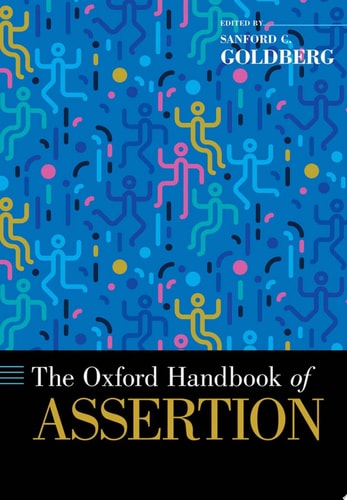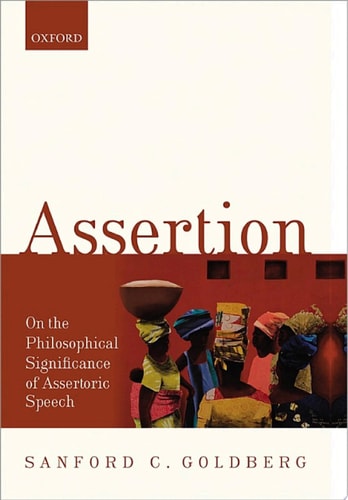
Assertion: On the Philosophical Significance of Assertoric Speech
0
0
As an Amazon Associate and affiliate partner, Menrva Books earns from qualifying purchases. Learn more
Author Description
Sanford C. Goldberg presents a novel account of the speech act of assertion. He defends the view that this type of speech act is answerable to a constitutive norm--the norm of assertion. The hypothesis that assertion is answerable to a robustly epistemic norm is uniquely suited to explain assertion's philosophical significance--its connections to other philosophically interesting topics. These include topics in epistemology (testimony and testimonial knowledge; epistemic authority; disagreement), the philosophy of mind (belief; the theory of mental content), the philosophy of language (norms of language; the method of interpretation; the theory of linguistic content), ethics (the ethics of belief; what we owe to each other as information-seeking creatures), and other matters which transcend any subcategory (anonymity; trust; the division of epistemic labor; Moorean paradoxicality). Goldberg aims to bring out these connections without assuming anything about the precise content of assertion's norm, beyond regarding it as robustly epistemic. In the last section of the book, however, he proposes that we do best to see the norm's epistemic standard as set in a context-sensitive fashion. After motivating this proposal by appeal to Grice's Cooperative Principle and spelling it out in terms of what is mutually believed in the speech context, Goldberg concludes by noting how this sort of context-sensitivity can be made to square with assertion's philosophical significance.
Menrva's Summary
THE THESIS
What is the philosophical significance of the speech act of assertion, and how does its adherence to a constitutive epistemic norm explain its broader role in human communication? Sanford C. Goldberg, a prominent philosopher of language and epistemology, investigates the normative structure of assertion. He argues that assertion is governed by a robustly epistemic norm, which serves as the foundation for understanding its connections to testimony, belief, and social trust. By avoiding overly restrictive definitions of the norm's content, Goldberg constructs a framework that links linguistic practice to fundamental questions in ethics and the philosophy of mind.
THE SCOPE MAP
What You Will Find
- A comprehensive analysis of the constitutive norms governing assertoric speech.
- An exploration of the intersection between assertion and epistemic authority, disagreement, and testimonial knowledge.
- A proposed model for the context-sensitivity of epistemic standards based on Grice's Cooperative Principle.
- Discussions on the ethics of belief and the division of epistemic labor.
Scope Limits
- The text does not provide a definitive, singular definition of the norm's content, focusing instead on its epistemic nature.
- The analysis does not cover non-assertoric speech acts or performative utterances outside the scope of information-seeking communication.
THE AUTHORITY PERSPECTIVE
Experts in the field of analytic philosophy identify this work as a significant contribution to the ongoing debate regarding the norms of assertion. Readers frequently note the academic density of the prose, which requires a strong background in contemporary epistemology and philosophy of language to fully synthesize.
Page Count:
336
Publication Date:
2015-01-01
Publisher:
OUP Oxford
ISBN-10:
0191046329
ISBN-13:
9780191046322
Philosophy
Ethics
Linguistics
Philosophy of
Epistemology
Community Tags
Similar Books