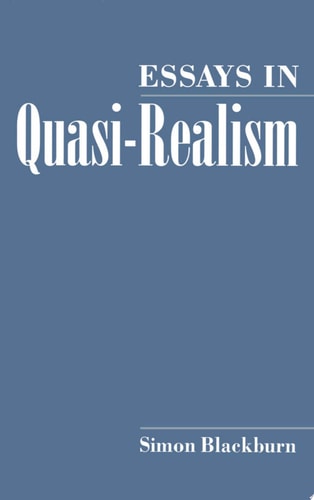
Essays in Quasi-Realism
0
0
As an Amazon Associate and affiliate partner, Menrva Books earns from qualifying purchases. Learn more
Author Description
This volume collects some influential essays in which Simon Blackburn, one of our leading philosophers, explores one of the most profound and fertile of philosophical problems: the way in which our judgments relate to the world. This debate has centered on realism, or the view that what we say is validated by the way things stand in the world, and a variety of oppositions to it. Prominent among the latter are expressive and projective theories, but also a relaxed pluralism that discourages the view that there are substantial issues at stake. The figure of the "quasi-realist" dramatizes the difficulty of conducting these debates. Typically philosophers thinking of themselves as realists will believe that they alone can give a proper or literal account of some of our attachments--to truth, to facts, to the independent world, to knowledge and certainty. The quasi-realist challenge, developed by Blackburn in this volume, is that we can have those attachments without any metaphysic that deserves to be called realism, so that the metaphysical picture that goes with our practices is quite idle. The cases treated here include the theories of value and knowledge, modality, probability, causation, intentionality and rule-following, and explanation. A substantial new introduction has been added, drawing together some of the central themes. The essays articulate a fresh alternative to a primitive realist/anti-realist opposition, and their cumulative effect is to yield a new appreciation of the delicacy of the debate in these central areas.
Menrva's Summary
THE THESIS
This collection investigates the core philosophical problem of how human judgments relate to the objective world, specifically challenging the necessity of metaphysical realism. Simon Blackburn, a prominent philosopher, utilizes these essays to argue that one can maintain commitments to truth, facts, and knowledge without adhering to a traditional realist metaphysic. He proposes a 'quasi-realist' framework, suggesting that the metaphysical baggage often associated with our linguistic and cognitive practices is largely idle.
THE SCOPE MAP
What You Will Find
- Analysis of the realist versus anti-realist debate in contemporary philosophy
- Theoretical exploration of value, knowledge, modality, and probability
- Examination of causation, intentionality, and rule-following
- A substantial introduction synthesizing central themes across the essays
Scope Limits
- The text does not provide a comprehensive history of analytic philosophy
- It does not offer a practical guide for non-academic readers
THE AUTHORITY PERSPECTIVE
Experts recognize this volume as a foundational text for understanding the quasi-realist position in meta-ethics and metaphysics. Readers frequently note the academic density of the prose, which requires a strong background in philosophical terminology to fully grasp the arguments presented.
Page Count:
262
Publication Date:
1993-01-01
Publisher:
Oxford University Press
ISBN-10:
0190281987
ISBN-13:
9780190281984
Philosophy
Ethics
Realism
Epistemology
Metaphysics
Logic
Community Tags
Similar Books