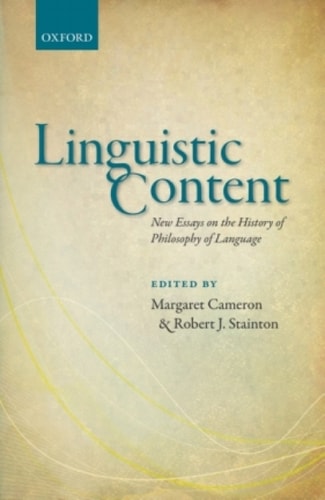
Linguistic Content: New Essays on the History of Philosophy of Language
0
0
As an Amazon Associate and affiliate partner, Menrva Books earns from qualifying purchases. Learn more
Author Description
Philosophy of language has a rich and varied history stretching back to the Ancient Greeks. Twelve specially written essays explore this richness, from Plato and Aristotle, through the Stoics, to medieval thinkers, both Islamic and Christian; from the Renaissance and the early modern period, all the way up to the twentieth Century. Among the many topics that arise across this 2500-year trajectory are metaphysical questions about linguistic content. A first focal point of the volume is the issue of which broad ontological family linguistic contents belong to. Are linguistic contents mental ideas, physical particulars, abstract Forms, social practices, or something else again? And do different sorts of linguistic contents belong to different ontological categories-e.g., might it be that names stand for ideas, whereas logical terms stand for mental processes? The second focal point is the metaphysical grounding of linguistic content: that is, in virtue of what more basic facts do content facts obtain? Do words mean what they do because of natural resemblances? Because of causal relations? Because of arbitrary conventional usage? Or because of some combination of the above?
Menrva's Summary
THE THESIS
This collection of essays investigates the ontological status and metaphysical grounding of linguistic content across 2500 years of philosophical inquiry. Editors Margaret E. Cameron and Robert J. Stainton curate twelve original contributions that analyze how various thinkers, from the Ancient Greeks to twentieth-century philosophers, have defined the nature of meaning. The volume seeks to determine whether linguistic content is best categorized as mental, physical, or abstract, while examining the foundational mechanisms—such as convention or causality—that give words their meaning.
THE SCOPE MAP
What You Will Find
- Historical analysis spanning from Plato and Aristotle through the Stoics to medieval Islamic and Christian thinkers.
- Examination of Renaissance and early modern perspectives on language.
- Comparative study of ontological categories including mental ideas, physical particulars, and abstract Forms.
- Theoretical exploration of the grounding of content in natural resemblance versus arbitrary convention.
Scope Limits
- The volume does not provide a comprehensive survey of every philosopher in the history of language.
- It focuses specifically on metaphysical questions rather than purely syntactic or grammatical structures.
THE AUTHORITY PERSPECTIVE
Scholars and students of philosophy frequently identify this collection as a rigorous resource for understanding the historical development of semantic theory. Experts highlight the volume for its ability to bridge the gap between ancient metaphysical inquiry and contemporary debates in the philosophy of language.
Page Count:
280
Publication Date:
2015-01-01
Publisher:
OUP Oxford
ISBN-10:
0191046337
ISBN-13:
9780191046339
Philosophy
Linguistics
Metaphysics
Philosophy history
English
English & College Success
Philosophy of
History & Surveys
Community Tags
Similar Books