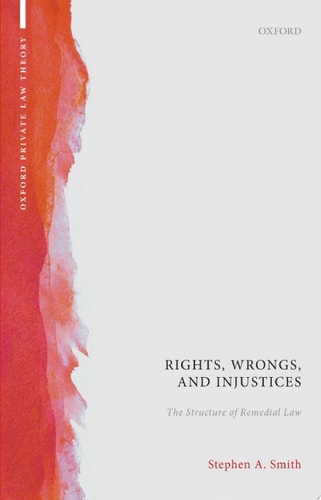
Rights, Wrongs, and Injustices: The Structure of Remedial Law
0
0
As an Amazon Associate and affiliate partner, Menrva Books earns from qualifying purchases. Learn more
Author Description
Rights, Wrongs, and Injustices is the first comprehensive account of the scope, foundations, and structure of remedial law in common law jurisdictions. The rules governing the kinds of complaints that common law courts will accept are generally well understood. However, the rules governing when and how they respond to such complaints are not. This book provides that understanding. It argues that remedies are judicial rulings, and that remedial law is the law governing their availability and content. Focusing on rulings that resolve private law disputes (for example, damages, injunctions, and restitutionary orders), this book explains why remedial law is distinctive, how it relates to substantive law, and what its foundational principles are. The book advances four main arguments. First, the question of what courts should do when individuals seek their assistance (the focus of remedial law) is different from the question of how individuals should treat one another in their day-to-day lives (the focus of substantive law). Second, remedies provide distinctive reasons to perform the actions they command; in particular, they provide reasons different from those provided by either rules or sanctions. Third, remedial law has a complex relationship to substantive law. Some remedies are responses to rights-threats, others to wrongs, and yet others to injustices. Further, remedies respond to these events in different ways: while many remedies (merely) replicate substantive duties, others modify substantive duties and some create entirely new duties. Finally, remedial law is underpinned by general principles-principles that cut across the traditional distinctions between so-called “legal” and “equitable” remedies. Together, these arguments provide an understanding of remedial law that takes the concept of a remedy seriously, classifies remedies according to their grounds and content, illuminates the relationship between remedies and substantive law, and presents remedial law a
Menrva's Summary
THE THESIS
What are the foundational principles and structural mechanisms that govern how common law courts determine the availability and content of remedies in private law disputes? Stephen A. Smith, a scholar of private law theory, examines the often-overlooked rules governing judicial responses to legal complaints. By distinguishing between substantive law—which dictates daily conduct—and remedial law—which dictates judicial action—the author constructs a framework to explain why remedies are distinct judicial rulings. The text utilizes a systematic analysis of common law jurisdictions to argue that remedial law functions through specific principles that transcend the traditional divide between legal and equitable remedies.
THE SCOPE MAP
What You Will Find
- A comprehensive taxonomy of remedies including damages, injunctions, and restitutionary orders.
- A theoretical framework distinguishing between rights-threats, wrongs, and injustices as grounds for judicial intervention.
- An analysis of the relationship between substantive duties and remedial modifications.
Scope Limits
- The analysis is primarily restricted to common law jurisdictions.
- The text focuses on private law disputes rather than public or criminal law contexts.
THE AUTHORITY PERSPECTIVE
Legal scholars and practitioners view this work as a significant contribution to the understanding of private law theory, particularly for its attempt to systematize remedial law. Readers frequently note the high level of academic density and the rigorous analytical approach required to engage with the author's arguments.
Page Count:
359
Publication Date:
2019-01-01
Publisher:
OUP Oxford
ISBN-10:
0191058750
ISBN-13:
9780191058752
Legal Theory
Private Law
Remedies Law
Law
Jurisprudence
Professional Career & Trade
Remedial Law
Community Tags
Similar Books