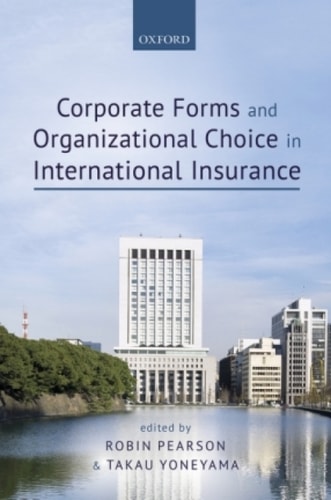
Corporate Forms and Organisational Choice in International Insurance
0
0
As an Amazon Associate and affiliate partner, Menrva Books earns from qualifying purchases. Learn more
Author Description
Given the infinite variety of risks throughout history, it is perhaps unsurprising that insurance - the world's primary risk mitigation industry - developed a wide range of organisational forms by which it was delivered. Yet we know little about how and why different forms were chosen in the past, or why they survived or disappeared. This book is the first to examine the development of multiple organisational forms in insurance from an historical and international comparative context, and to relate historical analysis to modern organisational theory. Thirteen chapters cover eight major markets, US, UK, Germany, Japan, Spain, Sweden, Australia, South Africa, which together account for over half of all world insurance today. Each chapter is authored by an expert in their field, and several include new datasets. Major themes covered are the variety, choice, governance and regulation of organisational forms in insurance, the experience of mutual insurance in frontier economies and uncertain political environments, the long-run business performance of different organisational forms, and the problems surrounding the demutualization of modern insurance companies. The book suggests the need for important revisions to current organisational theory, and it highlights several explanatory factors that have received little attention from scholars. These include the importance of regulation and the role of the state in shaping the organisational landscape of insurance at different times and places; the role of entrepreneurship in organisational choice; the utility of organisational forms as a risk management device, and the significance of cultural preferences in the selection of organisational forms.
Menrva's Summary
THE THESIS
This book investigates the historical evolution and selection of diverse organizational forms within the international insurance industry to determine why specific structures persisted or failed. Authors Robin Pearson and Takau Yoneyama, both established scholars in economic and business history, synthesize contributions from international experts to bridge the gap between historical case studies and contemporary organizational theory. The text argues that current theoretical frameworks require revision to account for the significant influence of state regulation, cultural preferences, and entrepreneurial decision-making in shaping market landscapes.
THE SCOPE MAP
What You Will Find
- Comparative analysis of eight major insurance markets: US, UK, Germany, Japan, Spain, Sweden, Australia, and South Africa.
- Examination of mutual insurance performance in frontier economies and politically unstable environments.
- Analysis of the long-run business performance and governance structures of various insurance entities.
- Discussion on the complexities and consequences of modern demutualization processes.
Scope Limits
- The analysis is restricted to the eight specified national markets and does not provide a comprehensive global survey of all insurance jurisdictions.
- The text focuses primarily on organizational structure and governance rather than the technical actuarial or mathematical aspects of risk pricing.
THE AUTHORITY PERSPECTIVE
Experts identify this work as a significant contribution to business history, particularly for its integration of new datasets across diverse international markets. Readers frequently note the academic density of the prose, which serves as a specialized resource for researchers in economic history and organizational economics.
Page Count:
272
Publication Date:
2015-01-01
Publisher:
OUP Oxford
ISBN-10:
0191059471
ISBN-13:
9780191059476
Business
Economics
History
Insurance
Finance
Organizational Theory
Community Tags
Similar Books