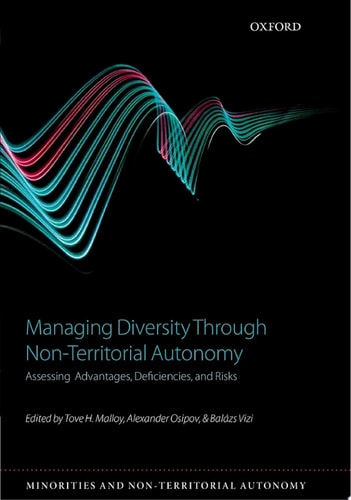
Managing Diversity through Non-Territorial Autonomy: Assessing Advantages, Deficiencies, and Risks
0
0
As an Amazon Associate and affiliate partner, Menrva Books earns from qualifying purchases. Learn more
Author Description
Non-territorial autonomy (NTA) is a statecraft tool that is increasingly gaining importance in societies seeking to accommodate demands by ethno-cultural groups for a voice in cultural affairs important to the protection and preservation of their identity, such as language, education, and religion. As states recognize the specific rights of identity minorities in multicultural and multi-ethnic societies, they are faced with a need to improve their diversity management regimes. NTA offers policy-makers a range of options for institutional design adaptable to specific circumstances and historical legacies. It devolves degrees of power through legal frameworks and institutions in specific areas of ethno-cultural life, while maintaining social unity at the core level of society. Throughout Europe and North America, NTA exists and is implemented at a state, regional, and local level. Much has been written about the concept of autonomy and its usage as a statecraft tool in states facing regional division, but little literature addresses its non-territorial institutional and public administration functions. This edited volume seeks to fill this gap. Managing Diversity through Non-Territorial Autonomy: Assessing Advantages, Deficiencies, and Risks, carves a space for contextual knowledge production on NTA in law, as well as social and political sciences. Contextual knowledge involves a description of institutions and their functionality as well as of the institutional and legal frames protecting these. What are the institutions, bodies, and functions that ethno-cultural groups can draw on when seeking to have a voice over their own affairs, as well as over issues in society related to their identity production? How are these entities incorporated and empowered to have a voice? What degree of voice do they have, and how are they designed to project this voice? Thus, contextual knowledge also involves critical assessment and risk analysis as well as penetrating insights as to
Menrva's Summary
THE THESIS
This volume investigates the efficacy and structural risks of non-territorial autonomy (NTA) as a mechanism for managing ethno-cultural diversity within modern state frameworks. The editors, Alexander Osipov, Balázs Vizi, and Tove H. Malloy, compile interdisciplinary research to evaluate how legal and institutional designs allow minority groups to exercise control over cultural affairs—such as language, education, and religion—without necessitating territorial secession or regional division. The text provides a critical analysis of how these administrative tools function in practice across various European and North American contexts.
THE SCOPE MAP
What You Will Find
- Comparative analysis of institutional designs for minority representation.
- Examination of legal frameworks governing ethno-cultural autonomy.
- Case studies detailing the practical implementation of NTA at state, regional, and local levels.
Scope Limits
- The text does not provide a comprehensive global survey of all existing autonomy models.
- It does not offer a prescriptive manual for policy implementation but focuses on analytical assessment.
THE AUTHORITY PERSPECTIVE
Experts identify this volume as a significant contribution to the literature on minority rights and public administration, specifically for its focus on non-territorial institutional functions. Scholars frequently note the academic density of the prose, making it a valuable resource for researchers and policy analysts interested in the mechanics of multicultural governance.
Page Count:
336
Publication Date:
2015-01-01
Publisher:
OUP Oxford
ISBN-10:
0191058335
ISBN-13:
9780191058332
Minority Rights
American Government
Professional Career & Trade
Law
Public Administration
Sociology
Community Tags
Other Editions(2)

Similar Books














Reader Comments
Share Your Thoughts
No comments yet. Be the first to share your thoughts!