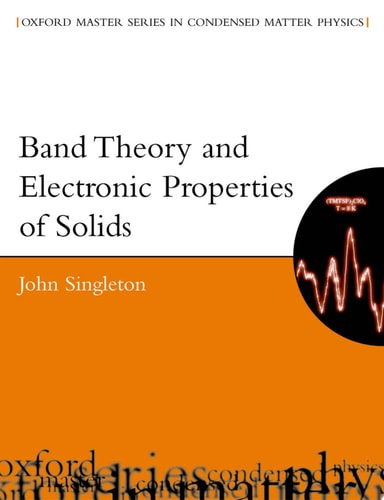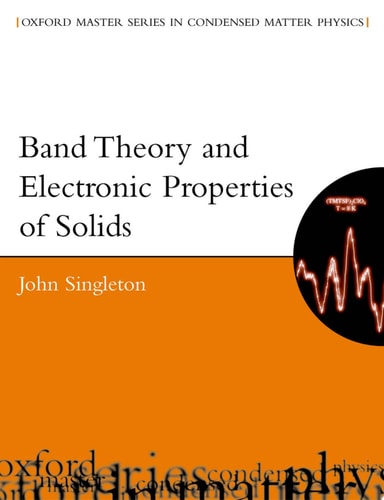
Band Theory and Electronic Properties of Solids
0
0
As an Amazon Associate and affiliate partner, Menrva Books earns from qualifying purchases. Learn more
Author Description
This book provides an introduction to band theory and the electronic properties of materials at a level suitable for final-year undergraduates or first-year graduate students. It sets out to provide the vocabulary and quantum-mechanical training necessary to understand the electronic, optical and structural properties of the materials met in science and technology and describes some of the experimental techniques which are used to study band structure today. In order to leave space for recent developments, the Drude model and the introduction of quantum statistics are treated synoptically. However, Bloch's theorem and two tractable limits, a very weak periodic potential and the tight-binding model, are developed rigorously and in three dimensions. Having introduced the ideas of bands, effective masses and holes, semiconductor and metals are treated in some detail, along with the newer ideas of artificial structures such as super-lattices and quantum wells, layered organic substances and oxides. Some recent `hot topics' in research are covered, e.g. the fractional Quantum Hall Effect and nano-devices, which can be understood using the techniques developed in the book. In illustrating examples of e.g. the de Haas-van Alphen effect, the book focuses on recent experimental data, showing that the field is a vibrant and exciting one. References to many recent review articles are provided, so that the student can conduct research into a chosen topic at a deeper level. Several appendices treating topics such as phonons and crystal structure make the book self-contained introduction to the fundamentals of band theory and electronic properties in condensed matter physic today.
Menrva's Summary
THE THESIS
This text investigates the fundamental principles of band theory and the electronic properties of solids within the context of modern condensed matter physics. John Singleton, an experienced researcher in the field, provides a structured pedagogical framework designed for advanced undergraduates and early-stage graduate students. The book synthesizes core quantum-mechanical concepts with contemporary experimental data to bridge the gap between theoretical models and current technological applications.
THE SCOPE MAP
What You Will Find
- Rigorous development of Bloch's theorem and the tight-binding model in three dimensions.
- Analysis of semiconductors, metals, and artificial structures like super-lattices and quantum wells.
- Coverage of advanced research topics including the fractional Quantum Hall Effect and nano-devices.
- Appendices detailing phonons and crystal structure to ensure self-contained study.
Scope Limits
- The Drude model and quantum statistics are treated synoptically rather than exhaustively.
- The text assumes a prior foundational knowledge of undergraduate-level physics and mathematics.
THE AUTHORITY PERSPECTIVE
Experts and educators frequently cite this work as a clear, accessible entry point for students transitioning into specialized research in condensed matter physics. Readers often note the balance between rigorous theoretical derivation and the inclusion of relevant, modern experimental examples.
Page Count:
240
Publication Date:
2001-01-01
Publisher:
OUP Oxford
ISBN-10:
0191057460
ISBN-13:
9780191057465
textbook
Condensed Matter Physics
Physics
Earth Sciences
Solid-State Physics