
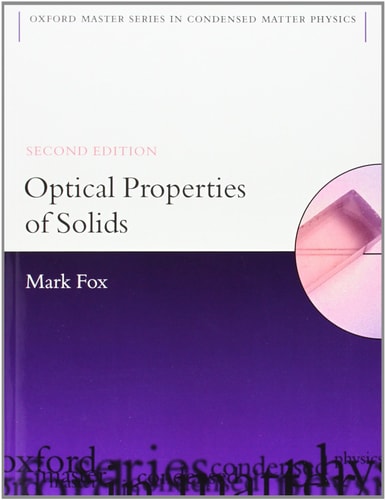
Optical Properties of Solids
0
0
As an Amazon Associate and affiliate partner, Menrva Books earns from qualifying purchases. Learn more
Author Description
The second edition of this successful textbook provides an up-to-date account of the optical physics of solid state materials. The basic principles of absorption, reflection, luminescence, and light scattering are covered for a wide range of materials, including insulators, semiconductors and metals. The text starts with a review of classical optics, and then moves on to the treatment of optical transition rates by quantum theory. In addition to the traditional discussion of crystalline materials, glasses and molecular solids are also covered. The first edition included a number of subjects that are not normally covered in standard texts, notably semiconductor quantum wells, molecular materials, vibronic solid state lasers, and nonlinear optics. The basic structure of the second edition is unchanged, but all of the chapters have been updated and improved. Futhermore, a number of important new topics have been added, including: · Optical control of spin · Quantum dots · Plasmonics · Negative refraction · Carbon nanostructures (graphene, nanotubes and fullerenes) · NV centres in diamond The text is aimed at final year undergraduates, masters students and researchers. It is mainly written for physicists, but might also be useful for electrical engineers, materials scientists and physical chemists. The topics are written in a clear tutorial style with worked examples, chapter summaries and exercises. A solutions manual is available on request for instructors.
Menrva's Summary
THE THESIS
This text investigates the fundamental principles governing the interaction of light with solid state materials, ranging from classical optics to advanced quantum mechanical transitions. Mark Fox, a physicist with extensive experience in the field, utilizes a pedagogical framework to bridge the gap between basic electromagnetic theory and contemporary research topics. The book synthesizes classical and quantum approaches to explain how insulators, semiconductors, and metals respond to optical stimuli, providing a rigorous foundation for students and researchers alike.
THE SCOPE MAP
What You Will Find
- Comprehensive coverage of absorption, reflection, luminescence, and light scattering.
- Theoretical treatment of optical transition rates using quantum mechanics.
- Analysis of modern materials including quantum dots, plasmonics, and carbon nanostructures.
- Pedagogical tools such as worked examples, chapter summaries, and end-of-chapter exercises.
Scope Limits
- The text assumes a prior understanding of undergraduate-level electromagnetism and basic quantum mechanics.
- It does not provide an exhaustive survey of every niche application in photonics, focusing instead on core physical principles.
THE AUTHORITY PERSPECTIVE
Experts and educators frequently cite this work as a standard, accessible resource for final-year undergraduates and graduate students in physics. Readers often note the clarity of the tutorial style, which effectively balances theoretical depth with practical application for students and researchers in related fields like electrical engineering.
Page Count:
408
Publication Date:
2010-01-01
Publisher:
OUP Oxford
ISBN-10:
0191576727
ISBN-13:
9780191576720
textbook
Optics
Solid-State Physics
Physics
Earth Sciences
Community Tags
Other Editions(4)
Similar Books
Reader Comments
Share Your Thoughts
No comments yet. Be the first to share your thoughts!