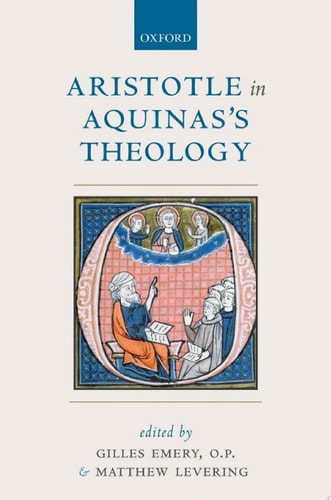
Aristotle in Aquinas's Theology
0
0
As an Amazon Associate and affiliate partner, Menrva Books earns from qualifying purchases. Learn more
Author Description
Aristotle in Aquinas's Theology explores the role of Aristotelian concepts, principles, and themes in Thomas Aquinas's theology. Each chapter investigates the significance of Aquinas's theological reception of Aristotle in a central theological domain: the Trinity, the angels, soul and body, the Mosaic law, grace, charity, justice, contemplation and action, Christ, and the sacraments. In general, the essays focus on the Summa theologiae, but some range more widely in Aquinas's corpus. For some time, it has above all been the influence of Aristotle on Aquinas's philosophy that has been the centre of attention. Perhaps in reaction to philosophical neo-Thomism, or perhaps because this Aristotelian influence appears no longer necessary to demonstrate, the role of Aristotle in Aquinas's theology presently receives less theological attention than does Aquinas's use of other authorities (whether Scripture or particular Fathers), especially in domains outside of theological ethics. Indeed, in some theological circles the influence of Aristotle upon Aquinas's theology is no longer well understood. Readers will encounter here the great Aristotelian themes, such as act and potency, God as pure act, substance and accidents, power and generation, change and motion, fourfold causality, form and matter, hylomorphic anthropology, the structure of intellection, the relationship between knowledge and will, happiness and friendship, habits and virtues, contemplation and action, politics and justice, the best form of government, and private property and the common good. The ten essays in this book engage Aquinas's reception of Aristotle in his theology from a variety of points of view: historical, philosophical, and constructively theological.
Menrva's Summary
THE THESIS
This volume investigates the extent and significance of Aristotelian philosophical principles within the theological framework of Thomas Aquinas. The editors, Gilles Emery and Matthew Levering, curate a collection of essays that address the perceived decline in scholarly attention toward Aquinas's theological use of Aristotle. By examining specific doctrines—ranging from the Trinity to the sacraments—the contributors argue that Aristotelian concepts remain vital to understanding the structural and logical coherence of Aquinas's theological project.
THE SCOPE MAP
What You Will Find
- Analysis of Aristotelian themes including act and potency, fourfold causality, and hylomorphic anthropology.
- Theological applications in domains such as the Trinity, grace, charity, and Christology.
- A focus primarily on the Summa theologiae alongside broader examination of the Thomistic corpus.
Scope Limits
- The text does not provide a general introduction to Aristotelian philosophy independent of its theological application.
- It does not offer an exhaustive historical survey of all medieval receptions of Aristotle outside the specific context of Aquinas's theology.
THE AUTHORITY PERSPECTIVE
Scholars and theologians identify this work as a significant contribution to contemporary Thomistic studies, particularly for its effort to bridge the gap between philosophical and theological readings of Aquinas. Readers frequently note the academic density of the prose, which assumes a foundational familiarity with both Aristotelian metaphysics and scholastic theology.
Page Count:
281
Publication Date:
2015-01-01
Publisher:
OUP Oxford
ISBN-10:
0191067504
ISBN-13:
9780191067501
Philosophy
Religion
Theology
Christian Theology
Thomism
Community Tags
Similar Books