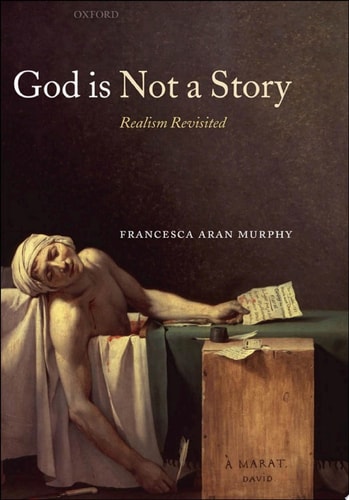
God Is Not a Story: Realism Revisited
0
0
As an Amazon Associate and affiliate partner, Menrva Books earns from qualifying purchases. Learn more
Author Description
A challenging critique of narrative theologies, including the works of George Lindbeck, Robert Jenson, and Herbert McCabe. Francesca Aran Murphy argues that the use of the concept of story or narrative in theology is circular and self-referential, and that the widespread notion that the role of the theologian is to 'tell God's story' has not helped theology to advance the reality of its doctrines. Murphy contends that the scriptural revelation on which Christian theology depends is not a story or a plot but a dramatic encounter between mysterious, free, and unpredictable persons. She offers her own alternative approach, making use of cinema and film theory, and engaging in particular in a dialogue with the work of Hans Urs von Balthasar.
Menrva's Summary
THE THESIS
Francesca Aran Murphy investigates whether the prevailing reliance on narrative frameworks in contemporary theology obscures the reality of divine doctrine. Murphy, a scholar of systematic theology, critiques the circular nature of narrative-based theological models by examining the works of prominent figures such as George Lindbeck, Robert Jenson, and Herbert McCabe. She argues that reducing scriptural revelation to a story limits the theological understanding of God as a free, unpredictable person, proposing instead a dramatic model informed by film theory and the work of Hans Urs von Balthasar.
THE SCOPE MAP
What You Will Find
- A critical analysis of narrative theology and its limitations in doctrinal development.
- A comparative study of theological methodologies including those of Lindbeck, Jenson, and McCabe.
- An alternative theological framework utilizing concepts from cinema and film theory.
- A sustained engagement with the dramatic theology of Hans Urs von Balthasar.
Scope Limits
- The text does not provide a comprehensive history of all narrative theology movements.
- The book focuses primarily on Christian theological discourse rather than comparative religious studies.
THE AUTHORITY PERSPECTIVE
Scholars and theologians frequently note the high level of academic density and the rigorous philosophical nature of Murphy's prose. Experts highlight this work as a significant intervention in the debate over the utility of narrative in systematic theology.
Page Count:
359
Publication Date:
2007-01-01
Publisher:
OUP Oxford
ISBN-10:
0191607681
ISBN-13:
9780191607684
Religion
Philosophy
Theology
Theology doctrinal
Narrative theology
Christian Theology
Film Theory
Community Tags
Similar Books