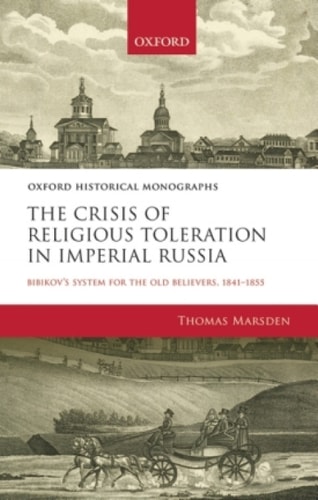
The Crisis of Religious Toleration in Imperial Russia: Bibikov's System for the Old Believers, 1841-1855
0
0
As an Amazon Associate and affiliate partner, Menrva Books earns from qualifying purchases. Learn more
Author Description
This book is about an unprecedented attempt by the government of Russia's Tsar Nicholas I (1825-1855) to eradicate what was seen as one of the greatest threats to its political security: the religious dissent of the Old Believers. The Old Believers had long been reviled by the ruling Orthodox Church, for they were the largest group of Russian dissenters and claimed to be the guardians of true Orthodoxy; however, their industrious communities and strict morality meant that the civil authorities often regarded them favourably. This changed in the 1840s and 1850s when a series of remarkable cases demonstrated that the existing restrictions upon the dissenters' religious freedoms could not suppress their capacity for independent organisation. Finding itself at a crossroads between granting full toleration, or returning to the fierce persecution of earlier centuries, the tsarist government increasingly inclined towards the latter course, culminating in a top secret 'system' introduced in 1853 by the Minister of Internal Affairs Dmitrii Bibikov. The operation of this system was the high point of religious persecution in the last 150 years of the tsarist regime: it dissolved the Old Believers' religious gatherings, denied them civil rights, and repressed their leading figures as state criminals. It also constituted an extraordinary experiment in government, instituted to deal with a temporary emergency. Paradoxically the architects of this system were not churchmen or reactionaries, but representatives of the most progressive factions of Nicholas's bureaucracy. Their abandonment of religious toleration on grounds of political intolerability reflected their nationalist concerns for the future development of a rapidly changing Russia. The system lasted only until Nicholas's death in 1855; however, the story of its origins, operation, and collapse, told for the first time in this study, throws new light on the religious and political identity of the autocratic regime and on the nature of the Russian state.
Menrva's Summary
THE THESIS
This book investigates the origins, implementation, and eventual collapse of the 1853 Bibikov system, a state-sponsored initiative designed to suppress the religious dissent of the Old Believers in Imperial Russia. Thomas Marsden, a historian specializing in the religious and political structures of the nineteenth-century Russian Empire, utilizes archival records and administrative correspondence to analyze how the tsarist bureaucracy navigated the tension between religious toleration and political security. The work argues that the persecution of the Old Believers was not merely a reactionary religious impulse, but a calculated, albeit short-lived, administrative experiment driven by nationalist concerns regarding the stability of the autocratic state.
THE SCOPE MAP
What You Will Find
- An analysis of the administrative policies under Tsar Nicholas I between 1841 and 1855.
- A detailed examination of the secret 'Bibikov system' and its impact on the civil rights of religious dissenters.
- Primary source evidence drawn from state archives and ministerial records.
Scope Limits
- The study focuses primarily on the period of 1841-1855 and does not provide a comprehensive history of the Old Believers beyond the mid-nineteenth century.
- The analysis is centered on the bureaucratic and political mechanisms of the state rather than the internal theological developments of the Old Believer communities.
THE AUTHORITY PERSPECTIVE
Scholars of Russian history identify this monograph as a significant contribution to the understanding of the relationship between the tsarist bureaucracy and religious minority groups. Readers frequently note the academic density of the prose and the precision with which the author reconstructs the political climate of the Nicholas I era.
Page Count:
270
Publication Date:
2015-01-01
Publisher:
OUP Oxford
ISBN-10:
0191063371
ISBN-13:
9780191063374
History
Religious History
Old Believers
Russian History
Academic
European History
Political History
Community Tags
Similar Books






Reader Comments
Share Your Thoughts
No comments yet. Be the first to share your thoughts!