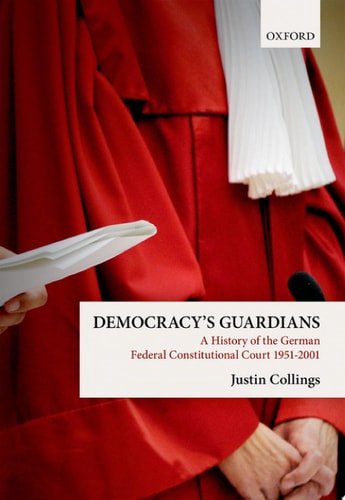
Democracy's Guardians: A History of the German Federal Constitutional Court, 1951-2001
0
0
As an Amazon Associate and affiliate partner, Menrva Books earns from qualifying purchases. Learn more
Author Description
In its six-decade history, the German Federal Constitutional Court has become one of the most powerful and influential constitutional tribunals in the world. It has played a central role in the establishment of liberalism, democracy, and the rule of law in post-war West Germany, and it has been a model for constitutional tribunals in many other nations. The Court stands virtually unchallenged as the most trusted institution of the German state. Written as a complete history of the German Federal Constitutional Court from its founding in 1951 up into the twenty-first century, this book explores how the court became so powerful, and why so few can resist its strength. Founded in 1951, the Court took root in a pre-democratic political culture. The Court's earliest contributions were to help establish liberal values and fundamental rights protection in the young Federal Republic. The early Court also helped democratize West German politics by reinforcing rights of speech and information, affirming the legitimacy of parliamentary opposition, and checking executive power. In time, as democratic values took hold in the country at large, the Court's early role in nurturing liberalism and democracy led many West Germans to view the Court not as a constraint on democracy, but as a bulwark of democracy's preconditions. In later decades, the Court played a stabilizing role - mediating political conflicts and integrating societal forces. Citizens disenchanted with partisan politics looked to the Court as a guardian of enduring values and a source of moral legitimacy. Through a comprehensive narrative of the Court's remarkable rise and careful analysis of its periodic crises, the work carefully dissects the success of the Court, presenting not only a traditional work of legal history, but a public history - both political and societal - as well as a doctrinal and jurisprudential account. Structured around the Court's major decisions from 1951 to 2001, the book examines popular an
Menrva's Summary
THE THESIS
This work investigates how the German Federal Constitutional Court evolved from its 1951 inception into one of the world's most influential and trusted judicial institutions. Justin Collings, a legal scholar, utilizes a comprehensive historical framework to analyze the Court's role in fostering liberal democracy within a post-war political culture that initially lacked democratic traditions. The text argues that the Court successfully transitioned from a nascent tribunal into a central pillar of German state legitimacy by balancing its role as a guardian of fundamental rights with its function as a mediator of political and societal conflict.
THE SCOPE MAP
What You Will Find
- A detailed historical account of the German Federal Constitutional Court from 1951 to 2001.
- Analysis of the Court's influence on speech rights, parliamentary opposition, and executive power.
- Examination of the Court's role in integrating societal forces and mediating political disputes.
- A synthesis of doctrinal legal history and broader political and social history.
Scope Limits
- The analysis concludes at the year 2001 and does not cover subsequent developments in the twenty-first century.
- The text focuses primarily on the German context and does not provide an exhaustive comparative study of other international tribunals.
THE AUTHORITY PERSPECTIVE
Legal scholars and historians recognize this work as a definitive account of the German Federal Constitutional Court's formative decades. Readers frequently note the balance between rigorous jurisprudential analysis and accessible political history, making it a standard reference for those studying the intersection of law and democratic stability.
Page Count:
373
Publication Date:
2015-01-01
Publisher:
OUP Oxford
ISBN-10:
0191067636
ISBN-13:
9780191067631
History
German history
Law
Courts_germany
Professional Career & Trade
Constitutional Law
Community Tags
Similar Books