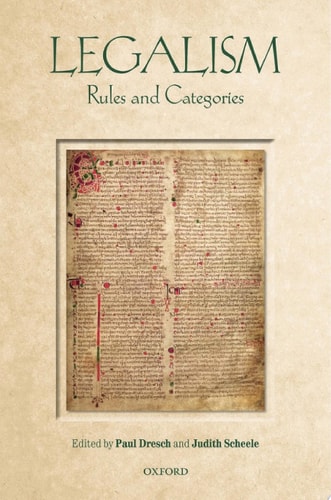
Legalism: Rules and Categories
0
0
As an Amazon Associate and affiliate partner, Menrva Books earns from qualifying purchases. Learn more
Author Description
Mainstream historians in recent decades have often treated formal categories and rules as something to be 'used' by individuals, as one might use a stick or stone, and the gains of an earlier legal history are often needlessly set aside. Anthropologists, meanwhile, have treated rules as analytic errors and categories as an imposition by outside powers or by analysts, leaving a very thin notion of 'practice' as the stuff of social life. Philosophy of an older vintage, as well as the work of scholars such as Charles Taylor, provides fresh approaches when applied imaginatively to cases beyond the traditional ground of modern Europe and North America. Not only are different kinds of rules and categories open to examination, but the very notion of a rule can be explored more deeply. This volume approaches rules and categories as constitutive of action and hence of social life, but also as providing means of criticism and imagination. A general theoretical framework is derived from analytical philosophy, from Wittgenstein to his critics and beyond, and from recent legal thinkers such as Schauer and Waldron. Case-studies are presented from a broad range of periods and regions, from Amazonia via northern Chad, Tibet, and medieval Russia to the scholarly worlds of Roman law, Islam, and Classical India. As the third volume in the Legalism series, this collection draws on common themes that run throughout the first two volumes: Legalism: Anthropology and History and Legalism: Community and Justice, consolidating them in a framework that suggests a new approach to rule-bound systems.
Menrva's Summary
THE THESIS
This volume investigates how formal rules and categories function as constitutive elements of social action rather than mere tools or analytical impositions. The authors, Judith Scheele and Paul Dresch, synthesize perspectives from analytical philosophy—drawing on Wittgenstein and contemporary legal theorists like Schauer and Waldron—to challenge the reductionist views held by historians and anthropologists. By applying these philosophical frameworks to diverse cultural and historical contexts, the book argues that rules provide the necessary structure for human imagination and social criticism.
THE SCOPE MAP
What You Will Find
- Theoretical framework integrating analytical philosophy with legal theory
- Comparative case studies spanning Amazonia, Chad, Tibet, medieval Russia, Roman law, Islam, and Classical India
- Analysis of the relationship between rule-bound systems and social practice
Scope Limits
- The text does not provide a comprehensive history of any single legal system
- It does not focus on modern Western legislative processes or contemporary policy implementation
THE AUTHORITY PERSPECTIVE
Scholars recognize this work as a significant contribution to the interdisciplinary study of legalism, particularly for its attempt to bridge the gap between anthropological practice and formal legal theory. Readers frequently note the academic density of the prose, which requires familiarity with philosophical discourse to fully grasp the proposed theoretical framework.
Page Count:
311
Publication Date:
2015-01-01
Publisher:
OUP Oxford
ISBN-10:
0191068322
ISBN-13:
9780191068324
Social Theory
Legal History
Cultural Anthropology
Professional Career & Trade
Anthropology
Rule Of Law
Academic
Law Philosophy
Procedure law
Community Tags
Similar Books