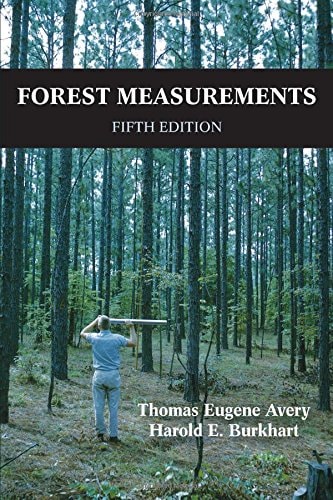
Forest Measurements
0
0
As an Amazon Associate and affiliate partner, Menrva Books earns from qualifying purchases. Learn more
Author Description
A textbook for introductory courses in forest measurement. Emphasizes measuring timber, but also describes measuring wood products and standing trees, predicting the growth of both individual trees and stands, and assessing range, wildlife, water, and recreational resources. Assumes only algebra and plane trigonometry, though statistics and calculus would be helpful. Revised from the 1983 edition based on suggestions from instructors. Annotation copyright Book News, Inc. Portland, Or.
Menrva's Summary
THE THESIS
This text investigates the fundamental methodologies and mathematical frameworks required for the accurate measurement and assessment of forest resources. Authors Harold E. Burkhart and Thomas Eugene Avery provide a structured approach to quantifying timber, wood products, and standing trees, while also addressing the complexities of growth prediction and resource management. The work serves as a foundational guide for students, requiring a basic proficiency in algebra and plane trigonometry to navigate the presented quantitative models.
THE SCOPE MAP
What You Will Find
- Quantitative methods for measuring individual trees and forest stands
- Techniques for assessing wood products and timber volume
- Models for predicting growth and yield in forest ecosystems
- Frameworks for evaluating range, wildlife, water, and recreational resources
Scope Limits
- Advanced statistical or calculus-based derivations are not the primary focus
- The text is limited to introductory-level forestry applications and does not cover specialized industrial engineering or advanced ecological modeling
THE AUTHORITY PERSPECTIVE
Experts recognize this work as a standard introductory text for forestry education, valued for its clear presentation of measurement techniques. Readers frequently note that while the prose is accessible, the practical application of the formulas requires consistent mathematical practice.
Page Count:
416
Publication Date:
1993-07-01
Publisher:
McGraw-Hill College
ISBN-10:
0070025568
ISBN-13:
9780070025561
Science
Forestry
Agriculture
Natural Resources
textbook
Community Tags
Other Editions(4)

Similar Books