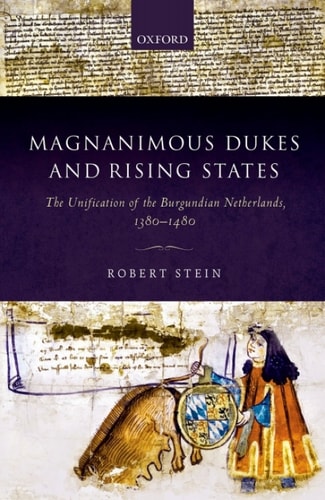
Magnanimous Dukes and Rising States: The Unification of the Burgundian Netherlands, 1380-1480
0
0
As an Amazon Associate and affiliate partner, Menrva Books earns from qualifying purchases. Learn more
Author Description
In the late fourteenth and the fifteenth centuries, the Dukes of Valois-Burgundy created a composite monarchy in the Netherlands, an area that had been dominated for centuries by several regional dynasties. In this way they laid the foundation for the modern states of the Netherlands, Belgium, and Luxemburg. The rise of the House of Burgundy can be read as the success story of a dynasty that in little over a century managed to assemble a great number of principalities, thus creating a new state. The Burgundian takeover, however, resulted in a modernization of administration, jurisdiction, and finances. The process of unification and the character of the union are the central topics of Magnanimous Dukes and Rising States. Robert Stein mirrors continuity and modernisation in Burgundian times with the bankruptcy of the former dynasties and the decline of feudal government. The powerful towns played an important background role; it was only with their support that a unification of the Netherlands was possible, but this support was not unselfish. This study is about the development of power relations and institutions in the field of tension between ruler and subject, between centralisation and particularism.
Menrva's Summary
THE THESIS
This study investigates how the Valois-Burgundy dynasty transformed a collection of regional principalities into a unified composite monarchy between 1380 and 1480. Robert Stein, an expert in late medieval history, utilizes administrative and financial records to analyze the transition from feudal governance to centralized statehood. The work argues that this unification was not merely a dynastic success but a structural modernization necessitated by the decline of older regional powers and the strategic cooperation of urban centers.
THE SCOPE MAP
What You Will Find
- Analysis of the administrative, judicial, and financial reforms implemented by the Valois-Burgundy dukes.
- Examination of the power dynamics between the centralizing monarchy and the autonomous towns.
- Historical assessment of the transition from feudalism to early modern state structures in the Low Countries.
Scope Limits
- The study focuses primarily on the political and institutional development of the Burgundian Netherlands rather than social or cultural history.
- The analysis is bounded by the specific timeframe of 1380 to 1480.
THE AUTHORITY PERSPECTIVE
Scholars recognize this work as a rigorous examination of the institutional mechanisms that facilitated the rise of the Burgundian state. Readers frequently note the academic density of the prose, which provides a detailed, evidence-based account of the tension between central authority and regional particularism.
Page Count:
368
Publication Date:
2017-01-01
Publisher:
OUP Oxford
ISBN-10:
0191078301
ISBN-13:
9780191078309
History
Netherlands history
Monarchy
European History
Politics & Government
Community Tags
Similar Books