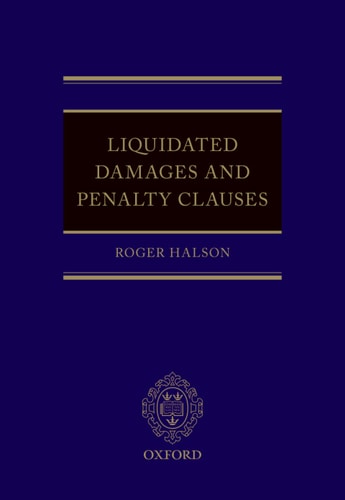
Liquidated Damages and Penalty Clauses
0
0
As an Amazon Associate and affiliate partner, Menrva Books earns from qualifying purchases. Learn more
Author Description
This, the only book in print to focus on liquidated damages and penalty clauses, analyses the common law jurisdiction to control stipulated damages clauses, and the distinction between enforceable liquidated damages clauses and unenforceable penalty clauses. The first part examines the historical origin of the control of these clauses, the second describes the current control of such clauses and their legal effect, the third critically examines the various rationales that have been proposed to justify their regulation and the final part describes analogous provisions and how to avoid drafting contractual clauses that are rendered unenforceable by the penalty rule. The book examines approaches in several common law jurisdictions in addition to England and Wales, including the United States, Australia, New Zealand, and Canada, and brings together principles developed in distinct commercial law contexts (such as shipping contracts) to enable comparison between particular contractual settings. Cited in the Court of Appeal, New Zealand, in 127 Hobson Street Ltd v Honey Bees Preschool Ltd [2019] NZCA 122 [18 April 2019]
Menrva's Summary
THE THESIS
This book investigates the legal mechanisms and jurisdictional standards used to distinguish between enforceable liquidated damages and unenforceable penalty clauses within contract law. Roger Halson, a recognized authority in contract law, provides a comprehensive analysis of the historical development and modern application of the penalty rule. By synthesizing case law and theoretical rationales, the text establishes a framework for understanding how courts evaluate stipulated damages in commercial agreements.
THE SCOPE MAP
What You Will Find
- Historical origins of the judicial control of stipulated damages.
- Comparative analysis of common law jurisdictions including England and Wales, the United States, Australia, New Zealand, and Canada.
- Practical guidance on drafting contractual clauses to avoid the penalty rule.
- Synthesis of principles across diverse commercial sectors such as shipping and construction.
Scope Limits
- The text focuses primarily on common law jurisdictions and does not provide an exhaustive survey of civil law systems.
- It is intended as a specialized legal resource rather than a general guide for non-legal professionals.
THE AUTHORITY PERSPECTIVE
Legal practitioners and scholars frequently cite this work as the definitive resource for navigating the complexities of penalty clauses in commercial contracts. Experts highlight the book's utility in both academic research and active litigation, noting its rigorous comparative approach.
Page Count:
238
Publication Date:
2018-01-01
Publisher:
OUP Oxford
ISBN-10:
0191087963
ISBN-13:
9780191087967
Law
Contract law
Professional Development
Professional Career & Trade
Commercial law
Great Britain