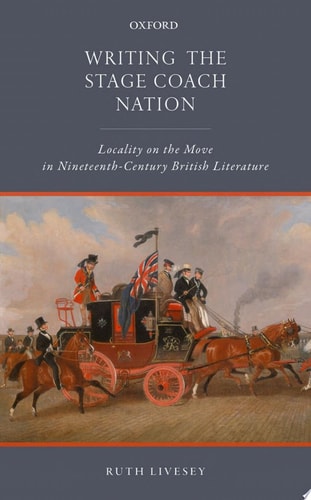
Writing the Stage Coach Nation
0
0
As an Amazon Associate and affiliate partner, Menrva Books earns from qualifying purchases. Learn more
Author Description
Why is it that so many of the best-loved novels of the Victorian era take place not in the steam-powered railway present in which they were published, but in the very recent past? Most works by Dickens, Brontë, Eliot, and Hardy set action neither in the present nor in a definitively historical epoch but rather in a 'just' past of collective memory, a vanishing but still tangible world moving by stage and mail coach. It is easy to overlook the fact that Jane Eyre, Bleak House, and Middlemarch, for example, are in this sense historical novels, recreating places and times that are just slipping from the horizon of here and now. Ruth Livesey brings to the surface the historical consciousness of such novels of the 'just' past and explores how they convey an idea of a national belonging that can be experienced through a sense of local place. The journey by public coach had long been an analogy for the form of the novel as it took shape in the eighteenth century; smooth engineered roads and the rapid circulation of print was one means by which Britain was reimagined as a modern, peaceable, and communicative nation in the aftermath of the Napoleonic Wars. But by the later 1840s the end of the stage coach was assured and that made it a highly charged figure of a lost national modernity. In its halts, relays, stops at inns, and crossing points, the stage and mail coach system offered a different experience of mobility and being-in-place—passages of flight and anchoring points—from the vectors of the railway that radiated out from industrial and urban centres. This book opens by examining the writing of the stage coach nation in Walter Scott's fiction and in the work of the radical journalists William Hazlitt and William Cobbett. Livesey suggests that in turning to the 'just' past of the stage coach imaginary, later novels by Dickens, Brontë, and Eliot reach out to the possibility of a nation knitted together by the affect of strongly felt local belonging.
Menrva's Summary
THE THESIS
This book investigates why Victorian novelists frequently set their narratives in the recent past of the stagecoach era rather than the contemporary age of steam-powered railways. Ruth Livesey, a scholar of Victorian literature, examines how this temporal displacement functions as a deliberate literary strategy. By analyzing the works of authors such as Dickens, Brontë, Eliot, and Hardy, she argues that these writers utilized the vanishing stagecoach system to construct a specific vision of national identity rooted in local belonging and collective memory.
THE SCOPE MAP
What You Will Find
- Analysis of the stagecoach as a symbol of lost national modernity in 19th-century literature.
- Examination of the transition from stagecoach travel to railway infrastructure in British cultural history.
- Comparative study of novelists including Walter Scott, Charles Dickens, Charlotte Brontë, and George Eliot.
- Exploration of radical journalism by William Hazlitt and William Cobbett.
Scope Limits
- The analysis focuses primarily on the British literary tradition and does not extend to international or colonial representations of transport.
- The study is limited to the period surrounding the decline of the stagecoach and the rise of the railway in the mid-19th century.
THE AUTHORITY PERSPECTIVE
Scholars recognize this work as a significant contribution to the study of Victorian historical consciousness and the spatial politics of the 19th-century novel. Readers frequently note the academic density of the prose, which provides a rigorous framework for understanding the intersection of transport history and narrative form.
Page Count:
240
Publication Date:
2016-01-01
Publisher:
Oxford University Press
ISBN-10:
0191082252
ISBN-13:
9780191082252
British History
Technology history
Victorian
Literary Criticism
Literary theory
Cultural History
Community Tags
Similar Books