The People’s Web Meets NLP
0
0
As an Amazon Associate and affiliate partner, Menrva Books earns from qualifying purchases. Learn more
Author Description
Collaboratively Constructed Language Resources (CCLRs) such as Wikipedia, Wiktionary, Linked Open Data, and various resources developed using crowdsourcing techniques such as Games with a Purpose and Mechanical Turk have substantially contributed to the research in natural language processing (NLP). Various NLP tasks utilize such resources to substitute for or supplement conventional lexical semantic resources and linguistically annotated corpora. These resources also provide an extensive body of texts from which valuable knowledge is mined. There are an increasing number of community efforts to link and maintain multiple linguistic resources. This book offers comprehensive coverage of CCLR-related topics, including their construction, utilization in NLP tasks, and interlinkage and management. Various Bachelor/Master/Ph.D. programs in natural language processing, computational linguistics, and knowledge discovery can use this book both as either main textbook or supplementary reading. The book also provides a valuable reference guide for researchers and professionals for the above topics.
Menrva's Summary
THE THESIS
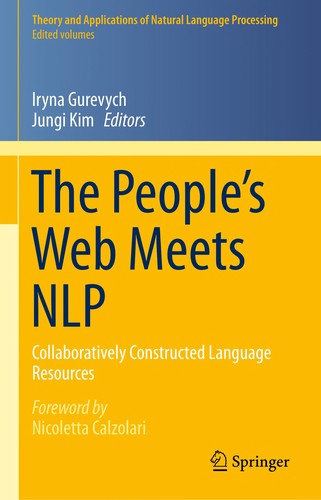
The People’s Web Meets NLP explores the significant impact of collaboratively constructed language resources (CCLRs) on natural language processing (NLP) research. It details how resources like Wikipedia and crowdsourced platforms have become vital for NLP tasks, supplementing traditional data sources and offering vast textual data for knowledge extraction. The book provides comprehensive coverage of CCLR construction, their application in NLP, and strategies for their interlinkage and management. It is designed to serve as a primary or supplementary text for academic programs in NLP and computational linguistics, as well as a reference for professionals and researchers in the field.
THE SCOPE MAP
- Construction methodologies for Collaboratively Constructed Language Resources (CCLRs)
- Utilization of CCLRs in various Natural Language Processing (NLP) tasks
- Strategies for interlinking and managing multiple linguistic resources
- Case studies on resources like Wikipedia, Wiktionary, Linked Open Data, Games with a Purpose, and Mechanical Turk
- Discussion of how CCLRs substitute for or supplement conventional lexical semantic resources and annotated corpora
- Analysis of knowledge mining from extensive textual bodies provided by CCLRs
THE AUTHORITY PERSPECTIVE
The book is positioned as a comprehensive resource for academic and professional audiences interested in the intersection of crowdsourced data and NLP. Its structure suggests a thorough examination of CCLR development and application, aiming to equip students and researchers with practical knowledge. The content is likely to appeal to those involved in computational linguistics, knowledge discovery, and advanced NLP research, offering insights into leveraging community-driven data for linguistic analysis.
Page Count:
378
Publication Date:
2013-01-01
ISBN-10:
3642350852
ISBN-13:
9783642350856
Non-Fiction
Science & Technology
Science
Computational linguistics
Community Tags
Similar Books