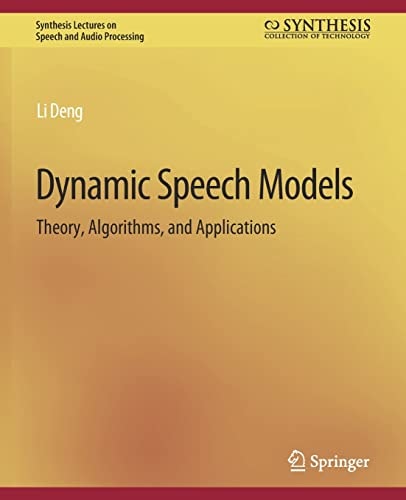
Dynamic Speech Models: Theory, Algorithms, and Applications
0
0
As an Amazon Associate and affiliate partner, Menrva Books earns from qualifying purchases. Learn more
Author Description
Speech dynamics refer to the temporal characteristics in all stages of the human speech communication process. This speech “chain” starts with the formation of a linguistic message in a speaker's brain and ends with the arrival of the message in a listener's brain. Given the intricacy of the dynamic speech process and its fundamental importance in human communication, this monograph is intended to provide a comprehensive material on mathematical models of speech dynamics and to address the following issues: How do we make sense of the complex speech process in terms of its functional role of speech communication? How do we quantify the special role of speech timing? How do the dynamics relate to the variability of speech that has often been said to seriously hamper automatic speech recognition? How do we put the dynamic process of speech into a quantitative form to enable detailed analyses? And finally, how can we incorporate the knowledge of speech dynamics into computerized speech analysis and recognition algorithms? The answers to all these questions require building and applying computational models for the dynamic speech process. What are the compelling reasons for carrying out dynamic speech modeling? We provide the answer in two related aspects. First, scientific inquiry into the human speech code has been relentlessly pursued for several decades. As an essential carrier of human intelligence and knowledge, speech is the most natural form of human communication. Embedded in the speech code are linguistic (as well as para-linguistic) messages, which are conveyed through four levels of the speech chain. Underlying the robust encoding and transmission of the linguistic messages are the speech dynamics at all the four levels. Mathematical modeling of speech dynamics provides an effective tool in the scientific methods of studying the speech chain. Such scientific studies help understand why humans speak as they do and how humans exploit redundancy and variability
Menrva's Summary
THE THESIS
This monograph investigates the complex temporal characteristics of human speech, known as speech dynamics, and their fundamental role in communication. The author, Li Deng, addresses how to quantify speech timing, its relationship to variability that hampers automatic speech recognition, and how to incorporate this knowledge into computational models. The book aims to provide a comprehensive understanding of mathematical models for speech dynamics, exploring their functional role from message formation in the speaker's brain to arrival in the listener's brain. It delves into the scientific inquiry of the human speech code, emphasizing speech dynamics as essential for the robust encoding and transmission of linguistic messages across four levels of the speech chain.
THE SCOPE MAP
- Mathematical models of speech dynamics
- Quantification of speech timing
- Relationship between speech dynamics and variability
- Incorporation of speech dynamics into computerized speech analysis
- Computational models for the dynamic speech process
- Scientific inquiry into the human speech code
- Analysis of speech dynamics at four levels of the speech chain
THE AUTHORITY PERSPECTIVE
The book provides a comprehensive treatment of mathematical models for speech dynamics, addressing key questions about speech timing, variability, and their integration into computational speech analysis. The author's approach aims to offer a quantitative framework for understanding the intricate process of human speech communication. The material is structured to facilitate detailed analyses and the development of more robust speech recognition algorithms. It serves as a valuable resource for researchers and practitioners in the field of speech processing and computational linguistics.
Page Count:
105
Publication Date:
2007-12-31
Publisher:
Springer International Publishing
ISBN-10:
3031014278
ISBN-13:
9783031014277
Non-Fiction
Science
Linguistics
Machine Learning
Speech Recognition
Computational linguistics
Community Tags
Other Editions(2)
Similar Books








Reader Comments
Share Your Thoughts
No comments yet. Be the first to share your thoughts!