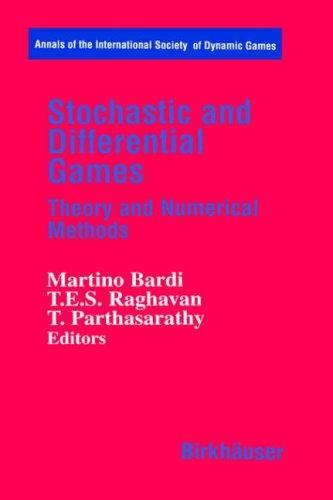
Stochastic and Differential Games
0
0
As an Amazon Associate and affiliate partner, Menrva Books earns from qualifying purchases. Learn more
Author Description
The theory of two-person, zero-sum differential games started at the be ginning of the 1960s with the works of R. Isaacs in the United States and L.S. Pontryagin and his school in the former Soviet Union. Isaacs based his work on the Dynamic Programming method. He analyzed many special cases of the partial differential equation now called Hamilton Jacobi-Isaacs-briefiy HJI-trying to solve them explicitly and synthe sizing optimal feedbacks from the solution. He began a study of singular surfaces that was continued mainly by J. Breakwell and P. Bernhard and led to the explicit solution of some low-dimensional but highly nontriv ial games; a recent survey of this theory can be found in the book by J. Lewin entitled Differential Games (Springer, 1994). Since the early stages of the theory, several authors worked on making the notion of value of a differential game precise and providing a rigorous derivation of the HJI equation, which does not have a classical solution in most cases; we mention here the works of W. Fleming, A. Friedman (see his book, Differential Games, Wiley, 1971), P.P. Varaiya, E. Roxin, R.J. Elliott and N.J. Kalton, N.N. Krasovskii, and A.I. Subbotin (see their book Po sitional Differential Games, Nauka, 1974, and Springer, 1988), and L.D. Berkovitz. A major breakthrough was the introduction in the 1980s of two new notions of generalized solution for Hamilton-Jacobi equations, namely, viscosity solutions, by M.G. Crandall and P.-L.
Menrva's Summary
THE THESIS
This book investigates the theoretical foundations and applications of differential games, focusing on two-person, zero-sum scenarios. It delves into the historical development of the field, tracing its origins to the works of Isaacs and Pontryagin, and explores the mathematical challenges in deriving and solving the Hamilton-Jacobi-Isaacs (HJI) equation, which often lacks classical solutions. The text examines generalized solution concepts, such as viscosity solutions, introduced by Crandall and Lions, to address these complexities.
THE SCOPE MAP
- Historical overview of two-person, zero-sum differential games starting from the 1960s.
- Detailed analysis of the Dynamic Programming method as applied by R. Isaacs.
- Exploration of the Hamilton-Jacobi-Isaacs (HJI) partial differential equation.
- Discussion of singular surfaces and their role in game solutions.
- Rigorous derivation of the HJI equation and its generalized solutions.
- Introduction to viscosity solutions for Hamilton-Jacobi equations.
- Coverage of key contributors and their seminal works in the field.
THE AUTHORITY PERSPECTIVE
The book provides a comprehensive historical and theoretical account of differential games, building upon foundational work by pioneers like Isaacs and Pontryagin. It addresses the mathematical intricacies of the Hamilton-Jacobi-Isaacs equation, including the development of generalized solution concepts like viscosity solutions. The text is structured to guide readers through the evolution of the field and its core mathematical frameworks. Its detailed exploration of theoretical underpinnings suggests it is a valuable resource for researchers and advanced students in mathematics and control theory.
Page Count:
380
Publication Date:
1999-01-01
ISBN-10:
0817640290
Science
Non-Fiction
Game theory
Control Theory
Mathematics
Community Tags
Similar Books