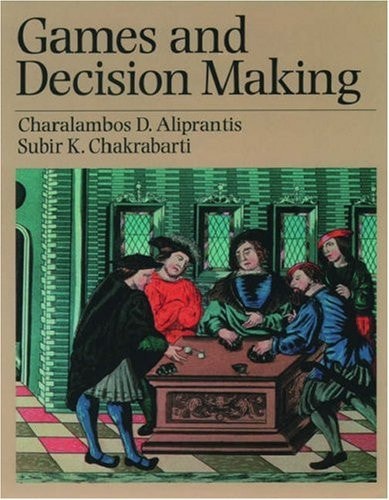
Games and Decision Making
0
0
As an Amazon Associate and affiliate partner, Menrva Books earns from qualifying purchases. Learn more
Author Description
Games and Decision Making is a self-contained introduction to basic issues and techniques of modern decision theory. From classical optimization to modern game theory, the authors show the increasing importance of mathematical knowledge for sustained competitive advantage in decision making. Students need only a basic understanding of elementary calculus and probability to use the book effectively.Through an imaginative selection of topics, the authors treat decision and game theory as part of one body of knowledge. They move from problems involving the individual decision-maker to progressively more complex problems such as sequential rationality, auctions, and bargaining. By building each chapter on material presented earlier, the authors avoid unnecessary confusion.The first chapter introduces optimization theory with a single decision-maker by using problems from finance and management to illustrate optimization techniques. Chapter two introduces the fundamentals of game theory by developing the theory of strategic form games and their solutions. The authors also present applications from a variety of sources including markets, voting, auctions, and resource extraction. Chapter three is devoted to sequential decision making, followed by two chapters on sequential games. The final chapters cover auctions and bargaining.Successfully class tested in a management science course at the Krannert School of Management, Games and Decision Making is an essential text for professors who need to have their students take a serious look at decision theory, whether at the undergraduate or masters level.
Menrva's Summary
THE THESIS
This text investigates the mathematical foundations and strategic frameworks required for effective decision-making in competitive environments. Authors Charalambos D. Aliprantis and Subir K. Chakrabarti utilize their expertise in economics and management science to synthesize classical optimization with modern game theory. The book provides a structured pedagogical approach, moving from individual decision-making models to complex multi-agent interactions, supported by applications in finance, voting, and resource management.
THE SCOPE MAP
What You Will Find
- Optimization theory for individual decision-makers using finance and management case studies.
- Fundamentals of strategic form games and their corresponding solution concepts.
- Sequential decision-making models and their application to multi-stage games.
- Advanced analysis of auction mechanisms and bargaining theory.
THE AUTHORITY PERSPECTIVE
Experts and educators recognize this work as a highly structured, self-contained resource suitable for both undergraduate and master-level curricula. Readers frequently note the clarity of the progression from basic calculus-based optimization to complex strategic interactions.
Page Count:
272
Publication Date:
1999-07-22
Publisher:
Oxford University Press
ISBN-10:
0195126092
ISBN-13:
9780195126099
Economics
Mathematics
Game theory
Decision Theory
Decision Making