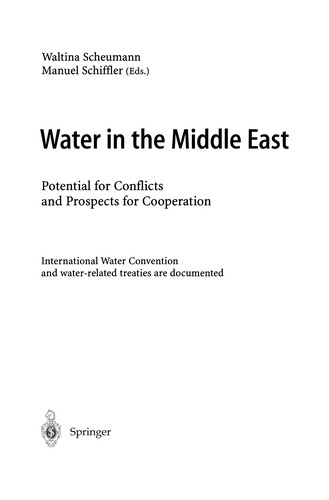
Water in the Middle East
0
0
As an Amazon Associate and affiliate partner, Menrva Books earns from qualifying purchases. Learn more
Author Description
In the 1980s, scientists, politicians and journalists frequently emphasized, particularly on the Jordan, Euphrates and Nile Rivers, that conflicts over shared water resources would lead to "water wars". A closer analysis shows that non-water issues have played the major role when conflicts in the region became heated, with the water issue being politically implemented. However, the unregulated and unequitable access to international rivers and the unilateral development of irrigated agriculture add to already high political tensions. The authors reveal that multilateral agreements over shared waters are a realistic option even in politically strained situations, if the expected costs of non-agreement are perceived as too high. If cooperation is beneficial to all Middle East nation states, it is easier to shift from overemphasis on national sovereignty to the concept of restricted national sovereignty and integrity which corresponds to international law.
Menrva's Summary
THE THESIS
The potential for "water wars" in the Middle East, particularly concerning the Jordan, Euphrates, and Nile Rivers, has been a recurring theme in scientific, political, and journalistic discourse since the 1980s. While historical conflicts have often been driven by non-water issues, the inequitable access to international rivers and unilateral agricultural development exacerbate existing political tensions. This analysis explores the conditions under which multilateral agreements over shared waters can become a realistic option, even amidst strained political relations, by demonstrating that the perceived costs of non-agreement can incentivize cooperation. The authors argue that if cooperation proves mutually beneficial, nations may shift from an overemphasis on absolute national sovereignty towards a concept of restricted sovereignty aligned with international law.
THE SCOPE MAP
- Analysis of historical water-related conflicts in the Middle East, focusing on the Jordan, Euphrates, and Nile Rivers.
- Examination of the role of non-water issues in regional conflicts versus the political implementation of water concerns.
- Investigation into the impact of unregulated and inequitable access to international rivers.
- Assessment of the consequences of unilateral development of irrigated agriculture on political tensions.
- Exploration of the conditions and feasibility of multilateral agreements over shared water resources.
- Discussion on the perception of costs associated with non-agreement as a driver for cooperation.
- Analysis of the shift from national sovereignty to restricted sovereignty in the context of international water law.
THE AUTHORITY PERSPECTIVE
The book examines the complex interplay between water resources and political conflict in the Middle East, challenging the simplistic notion that water scarcity inevitably leads to war. It posits that while water issues can exacerbate tensions, non-water factors often play a more significant role in escalating conflicts. The analysis suggests that multilateral agreements are achievable, particularly when the costs of non-cooperation are perceived as high by all parties involved. Ultimately, the work explores how a re-evaluation of national sovereignty in favor of internationally recognized principles can facilitate cooperation over shared water resources.
Page Count:
191
Publication Date:
1998-01-01
ISBN-10:
3642083765
ISBN-13:
9783642083761
History
Economics
Non-Fiction
Politics
International relations
Community Tags
Similar Books