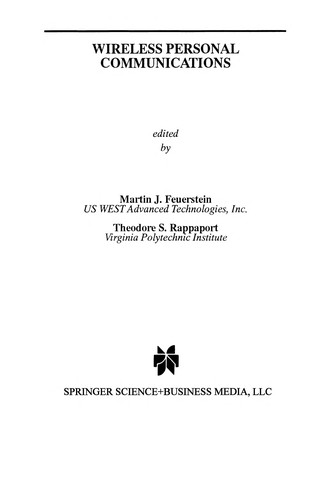
Wireless Personal Communications
0
0
As an Amazon Associate and affiliate partner, Menrva Books earns from qualifying purchases. Learn more
Author Description
In this book, the state-of-the-art and future vision of wireless communications is presented in the form of a number of new services. Wireless personal communications is clearly a different service than today's cellular radio or cordless telephone, but there is an evolutionary connection between the three services. This book addresses questions about what features of personal communication services (PCS) will be met by existing or enhanced digital cellular radio technology. The regulatory and standards aspects of wireless communications are currently in a crucial stage of their formulation. A section of the book is devoted to the opinions of representatives from regulatory agencies and standards organizations on the future of this critical area. One of the most intriguing questions about the future of wireless communications has to do with the choice of multiple access technique. The trade offs between time division multiple access (TDMA) and code division multiple access (CDMA) have been the topic of many a heated discussion amongst members of the wireless community. This book presents a thorough discussion of a number of the topics which are instrumental in making a fair comparison of TDMA and CDMA; these topics include: analytical performance evaluation techniques, capacity studies, equalization requirements, and shared spectrum comparisons. Many of the technologies associated with wireless personal communications are reaching the design stages. This book presents a number of alternatives for designs of both base stations and user terminals. Some of the key questions of equalization, control channel requirements, multi-path diversity and channel allocation strategies have been addressed. Invariably, system designs and performance are tied to the characteristics of the radio channel. This book introduces several novel techniques for predicting propagation and system performance in a variety of indoor and outdoor environments. These techniques include analytical as
Menrva's Summary
THE THESIS
This book investigates the current state and future trajectory of wireless personal communications, exploring the evolutionary links between existing cellular technologies and emerging personal communication services (PCS). Authored by Martin J. Feuerstein, this work delves into the critical regulatory and standards formulation stages of wireless communications, featuring insights from regulatory and standards organizations. It thoroughly examines the trade-offs between Time Division Multiple Access (TDMA) and Code Division Multiple Access (CDMA) by analyzing performance evaluation techniques, capacity studies, equalization requirements, and spectrum comparisons. Furthermore, the book presents design alternatives for base stations and user terminals, addressing key aspects like equalization, control channel requirements, multi-path diversity, and channel allocation strategies, while also introducing novel techniques for predicting radio channel propagation and system performance in various environments.
THE SCOPE MAP
- Analysis of new services and future visions in wireless communications.
- Exploration of the evolutionary connection between cellular radio, cordless telephones, and PCS.
- Discussion of how existing digital cellular radio technology can meet PCS features.
- Inclusion of opinions from regulatory agencies and standards organizations.
- Thorough comparison of TDMA and CDMA, including analytical performance evaluation, capacity studies, equalization, and shared spectrum.
- Presentation of design alternatives for base stations and user terminals.
- Addressing key design questions: equalization, control channel requirements, multi-path diversity, and channel allocation.
- Introduction of novel techniques for predicting propagation and system performance in indoor and outdoor environments.
THE AUTHORITY PERSPECTIVE
This book offers a comprehensive technical overview of wireless personal communications, focusing on the critical technological and regulatory aspects shaping the field in the early 1990s. It provides detailed analysis of competing multiple access techniques like TDMA and CDMA, alongside practical considerations for system design and radio channel prediction. The inclusion of regulatory perspectives and design alternatives makes it a valuable resource for engineers and policymakers navigating the evolving landscape of mobile communication.
Page Count:
320
Publication Date:
1993-01-01
ISBN-10:
1461363853
ISBN-13:
9781461363859
Science
Non-Fiction
Science & Technology
Engineering
Telecommunications
Community Tags
Similar Books