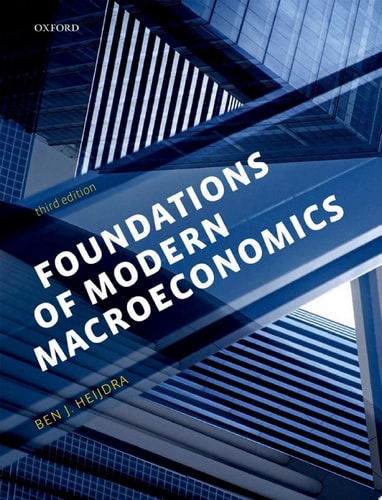
Foundations of Modern Macroeconomics
0
0
As an Amazon Associate and affiliate partner, Menrva Books earns from qualifying purchases. Learn more
Author Description
The study of macroeconomics can seem a daunting project. The field is complex and sometimes poorly defined and there are a variety of competing approaches. It is easy for the senior bachelor and starting master student to get lost in the forest of macroeconomics and the mathematics it uses extensively. Foundations of Modern Macroeconomics is a guide book for the interested and ambitious student. Non-partisan in its approach, it deals with all the major topics, summarising the important approaches and providing the reader with a coherent angle on all aspects of macroeconomic thought. Each chapter deals with a separate area of macroeconomics, and each contains a summary section of key points and a further reading list. Using nothing more than undergraduate mathematical skills, it takes the student from basic IS-LM style macro models to the state of the art literature on Dynamic Stochastic General Equilibrium, explaining the mathematical tricks used where they are first introduced. Fully updated and substantially revised, this third edition of Foundations of Modern Macroeconomics now includes brand new chapters covering highly topical subjects such as dynamic programming, competitive risk sharing equilibria and the New Keynesian DSGE approach.
Menrva's Summary
THE THESIS
This text investigates the core principles and mathematical frameworks required to navigate the complex, multi-faceted field of modern macroeconomics. Ben J. Heijdra, an established academic, provides a non-partisan synthesis of macroeconomic thought designed for senior undergraduate and graduate students. The book utilizes a structured pedagogical approach to bridge the gap between basic models and advanced research literature, ensuring students can grasp the mathematical rigor necessary for contemporary economic analysis.
THE SCOPE MAP
What You Will Find
- Comprehensive coverage of IS-LM models and Dynamic Stochastic General Equilibrium (DSGE) frameworks
- New chapters on dynamic programming and competitive risk sharing equilibria
- Pedagogical tools including chapter summaries and curated further reading lists
Scope Limits
- The text assumes the reader possesses foundational undergraduate-level mathematical skills
- It focuses on theoretical and model-based macroeconomics rather than applied policy history
THE AUTHORITY PERSPECTIVE
Experts and educators frequently highlight this text as a foundational resource for students transitioning into advanced macroeconomic theory. Readers often note the academic density of the prose, which is balanced by clear explanations of the mathematical techniques employed throughout the chapters.
Page Count:
936
Publication Date:
2017-01-01
Publisher:
OUP Oxford
ISBN-10:
0191086843
ISBN-13:
9780191086847
Economics
textbook
Finance
Macroeconomics
Principles of Macroeconomics
Academic
Community Tags
Other Editions(4)


Similar Books