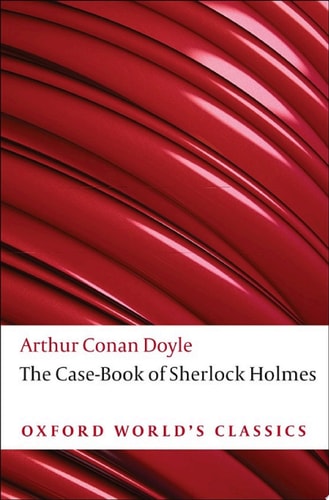
The Case-Book of Sherlock Holmes
0
0
As an Amazon Associate and affiliate partner, Menrva Books earns from qualifying purchases. Learn more
Author Description
In The Case-Book of Sherlock Holmes we read the last twelve stories Conan Doyle was to write about Holmes and Watson. They reflect the disillusioned world of the 1920s in which they were written, and he can be seen to take advantage of new, more open conventions in fiction. Suicide as a murder weapon and homosexual incest are some of the psychological tragedies whose consequences are unravelled by the mind of Holmes before the eyes of Watson. That said, the collection also includes some of the best turns of wit in the series, and indeed in the whole of English literature. The editor of this volume, W.W. Robson, is Emeritus David Masson, Professor of English Literature at the University of Edinburgh and the author of Modern English Literature. The general editor of the Oxford Sherlock Holmes, Owen Dudley Edwards, is Reader in History at the University of Edinburgh and author of The Quest for Sherlock Holmes. A Biographical Study of Sir Arthur Conan Doyle. ABOUT THE SERIES: For over 100 years Oxford World's Classics has made available the widest range of literature from around the globe. Each affordable volume reflects Oxford's commitment to scholarship, providing the most accurate text plus a wealth of other valuable features, including expert introductions by leading authorities, helpful notes to clarify the text, up-to-date bibliographies for further study, and much more.
Menrva's Summary
THE PULSE
Sherlock Holmes and Dr. Watson navigate a series of final, complex investigations that reflect the shifting social and psychological landscape of the post-war era. In this concluding collection of twelve short stories, the detective applies his deductive methodology to cases involving unconventional motives and darker human impulses. The narrative framework remains anchored in Watson's perspective, documenting the logical resolution of crimes that often defy traditional explanation. Holmes operates within a world increasingly influenced by the disillusionment of the 1920s, facing adversaries and moral dilemmas that test his analytical rigor.
INSIDE THE PAGES
- Twelve distinct short stories featuring Holmes and Watson
- Exploration of post-World War I social anxieties
- Shift toward more complex psychological motivations for crime
- Integration of unconventional narrative themes
- Maintenance of the classic deductive reasoning format
- Scholarly introduction by W. W. Robson
- Detailed explanatory notes on historical and literary context
- Updated bibliography for further research
THE COLLECTIVE ECHO
Discussion often centers on how these final stories represent a departure from the earlier, more formulaic adventures of the detective. Readers frequently highlight the darker, more cynical tone that permeates the collection, noting that the cases reflect the changing sensibilities of the 1920s. Critics often examine the evolution of Holmes as a character, observing how his methods remain consistent even as the nature of the crimes becomes more psychologically intricate. The balance between the traditional procedural structure and the introduction of more modern, challenging subject matter remains a primary focus for scholars and enthusiasts alike.
Page Count:
336
Publication Date:
1993-01-01
Publisher:
OUP Oxford
ISBN-10:
019150078X
ISBN-13:
9780191500787
Mystery
English
Short Stories
Classic Literature
Victorian
English & College Success
Edwardian
Detective
Community Tags
Similar Books