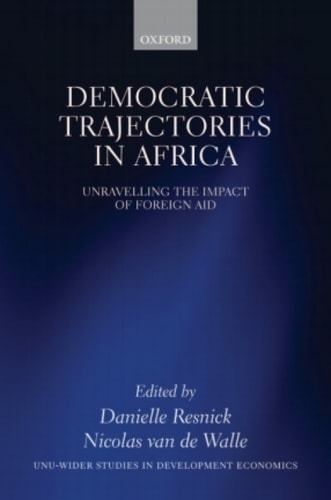
Democratic Trajectories in Africa: Unravelling the Impact of Foreign Aid
0
0
As an Amazon Associate and affiliate partner, Menrva Books earns from qualifying purchases. Learn more
Author Description
Despite impressive economic growth rates over the last decade, foreign aid still plays a significant role in Africa's political economies. This book asks when, why, and how foreign aid has facilitated, or hindered, democratization in sub-Saharan Africa. Instead of looking at foreign aid as a monolithic resource, the book examines the disparate impacts of aid specifically intended for development outcomes and aid explicitly aimed at democracy promotion. Careful attention is also given to examining the role of various aid modalities, including general budget support, and the influence of non-traditional donors. In doing so, the authors use a combination of cross-country quantitative analyses and in-depth case studies of Benin, Ghana, Malawi, Mali, Mozambique, Tanzania, and Zambia based on recent interviews with donors, government officials, and civil society organizations. Unlike other work on aid and democracy, the book carefully considers how foreign aid affects various elements of the democratization process, including transitions to multiparty systems and democratic consolidation. In terms of the latter, the authors analyse what role different types of aid play in avoiding a breakdown of multiparty democracy or an erosion of civil liberties, reinforcing parliaments and judiciaries, promoting free and fair elections and a vibrant civil society, and encouraging competitive party systems. Overall, the authors' findings suggest that the best means for enhancing the effectiveness of aid for development outcomes is not always the most optimal way of promoting democratic consolidation, and the book provides policy recommendations to try and reconcile these trade-offs.
Menrva's Summary
THE THESIS
This book investigates the complex relationship between foreign aid and the trajectory of democratization within sub-Saharan African nations. Authors Danielle Resnick and Nicholas van de Walle utilize their expertise in political economy to challenge the notion of aid as a monolithic force. By distinguishing between development-focused aid and democracy-promotion initiatives, they argue that the mechanisms of external assistance often create conflicting outcomes for political stability and democratic consolidation.
THE SCOPE MAP
What You Will Find
- Quantitative cross-country analyses of aid impacts across sub-Saharan Africa.
- In-depth case studies of Benin, Ghana, Malawi, Mali, Mozambique, Tanzania, and Zambia.
- Analysis of aid modalities including general budget support and the influence of non-traditional donors.
- Evaluation of aid effects on multiparty systems, civil liberties, and the strengthening of judicial and parliamentary institutions.
Scope Limits
- The study focuses primarily on sub-Saharan Africa and may not be generalizable to other developing regions.
- The analysis is bounded by the specific timeframe of recent political developments and donor practices.
THE AUTHORITY PERSPECTIVE
Experts and scholars in development economics frequently cite this work for its rigorous methodological approach in separating aid types. Readers often note the academic density of the prose, which serves as a foundational text for understanding the trade-offs between economic development and democratic institutionalization.
Page Count:
352
Publication Date:
2013-01-01
Publisher:
OUP Oxford
ISBN-10:
0191509809
ISBN-13:
9780191509803
Economics
Democracy
Africa
Public Policy
International relations
Community Tags
Similar Books