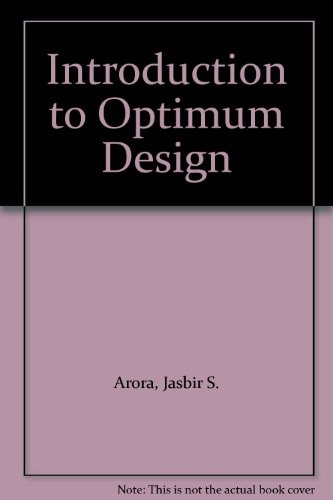
Introduction to Optimum Design
0
0
As an Amazon Associate and affiliate partner, Menrva Books earns from qualifying purchases. Learn more
Author Description
Optimization is a mathematical tool developed in the early 1960's used to find the most efficient and feasible solutions to an engineering problem. It can be used to find ideal shapes and physical configurations, ideal structural designs, maximum energy efficiency, and many other desired goals of engineering. This book is intended for use in a first course on engineering design and optimization. Material for the text has evolved over a period of several years and is based on classroom presentations for an undergraduate core course on the principles of design. Virtually any problem for which certain parameters need to be determined to satisfy constraints can be formulated as a design optimization problem. The concepts and methods described in the text are quite general and applicable to all such formulations. Inasmuch, the range of application of the optimum design methodology is almost limitless, constrained only by the imagination and ingenuity of the user. The book describes the basic concepts and techniques with only a few simple applications. Once they are clearly understood, they can be applied to many other advanced applications that are discussed in the text. * Allows engineers involved in the design process to adapt optimum design concepts in their work using the material in the text.* Basic concepts of optimality conditions and numerical methods are described with simple examples, making the material high teachable and learnable. * Classroom-tested for many years to attain optimum pedagogical effectiveness.
Menrva's Summary
THE THESIS
This text investigates the fundamental mathematical principles and numerical methods required to formulate and solve engineering design optimization problems. Jasbir S. Arora, a professor with extensive experience in structural and mechanical engineering, synthesizes years of classroom instruction into a structured pedagogical framework. The book argues that optimization is a universal tool applicable to any engineering scenario where parameters must be adjusted to satisfy specific constraints and performance goals.
THE SCOPE MAP
What You Will Find
- Mathematical foundations of optimality conditions
- Numerical methods for solving design optimization problems
- Practical applications in structural and mechanical configurations
- Pedagogical examples designed for undergraduate engineering students
Scope Limits
- Does not cover highly specialized or proprietary software-specific optimization algorithms
- Focuses primarily on introductory concepts rather than advanced research-level theoretical developments
THE AUTHORITY PERSPECTIVE
Experts and educators frequently cite this text as a foundational resource for introducing engineering students to the rigor of design optimization. Readers often note the clarity of the examples provided, which effectively bridge the gap between abstract mathematical theory and practical engineering application.
Page Count:
223
Publication Date:
1989-01-01
Publisher:
McGraw-Hill Inc.,US
ISBN-10:
0070024618
ISBN-13:
9780070024618
Engineering
Manufacturing Systems
textbook
Mathematics
Optimization
New Used & Rental Textbooks
Mechanical
Design