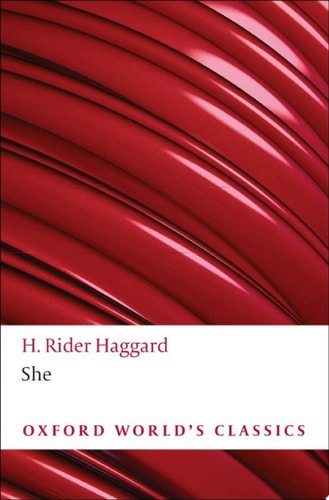
She
0
0
As an Amazon Associate and affiliate partner, Menrva Books earns from qualifying purchases. Learn more
Author Description
'My empire is of the imagination.' These are the words of Ayesha, the mysterious white queen of a Central African tribe, whose dread title, 'She-who-must-be-obeyed', testifies to her undying beauty and magical powers; but they serve equally well to describe the hold of her author, Henry Rider Haggard, on generations of readers. Writing 'at white heat', and in the flush of success after the publication of King Solomon's Mines, Haggard drew again on his knowledge of Africa and of ancient legends, but also on something deeper and more disturbing. To the Englishmen who journey through shipwreck, fever, and cannibals to her hidden realm, 'She' is the goal of a quest bequeathed to them two thousand years before; to Haggard's readers, 'She' is the embodiment of one of the most potent and ambivalent figures of Western mythology, a female who is both monstrous and desirable - and, without question, deadlier than the male. ABOUT THE SERIES: For over 100 years Oxford World's Classics has made available the widest range of literature from around the globe. Each affordable volume reflects Oxford's commitment to scholarship, providing the most accurate text plus a wealth of other valuable features, including expert introductions by leading authorities, helpful notes to clarify the text, up-to-date bibliographies for further study, and much more.
Menrva's Summary
THE PULSE
A perilous expedition into the uncharted interior of Africa leads two Englishmen to the discovery of a legendary, immortal queen who holds absolute power over a hidden civilization. Driven by a centuries-old family legacy, the protagonists navigate treacherous landscapes, hostile tribes, and physical exhaustion to locate the mysterious Ayesha. The narrative is presented through a frame story, utilizing a first-person perspective that documents the supernatural encounters and the psychological toll of the queen's influence. The world is defined by ancient ruins, occult phenomena, and the rigid social hierarchies of the Victorian era clashing with primitive isolation.
INSIDE THE PAGES
- Frame narrative structure utilizing a manuscript discovery device
- Exploration of themes regarding immortality and the corruption of power
- Vivid descriptions of subterranean environments and ancient architecture
- Integration of Victorian-era colonial perspectives on African geography
- Characterization of the central antagonist as a dualistic figure of beauty and terror
- Pacing that shifts from survival-based adventure to philosophical dialogue
- Use of supernatural elements to challenge the protagonists' rationalist worldviews
- Symbolic representation of the 'femme fatale' archetype within late 19th-century literature
THE COLLECTIVE ECHO
Discussion often centers on the complex and often contradictory portrayal of Ayesha as both a powerful female archetype and a manifestation of colonial anxieties. Readers frequently highlight the atmospheric world-building that defined the lost world genre for subsequent generations of writers. Critics often examine the text's reliance on Victorian tropes while acknowledging its influence on the development of speculative fiction. The pacing is noted for its transition from high-stakes physical survival to intense, dialogue-heavy sequences that explore the nature of eternal life. Many readers find the prose style reflective of its era, providing a window into the cultural preoccupations of the late 19th century.
Page Count:
320
Publication Date:
2008-01-01
Publisher:
OUP Oxford
ISBN-10:
0191504335
ISBN-13:
9780191504334
Adventure
Fantasy
Victorian
English & College Success
Lost World
Africa fiction
Adventure fiction
English
classic
Community Tags
Other Editions(12)

Natal Publishing, Llc
2024
Default edition
Independently Published
2020

Independently Published
2020

Independently Published
2019
CreateSpace Independent Publishing Platform
2018

CreateSpace Independent Publishing Platform
2017

Independently Published
2017

CreateSpace Independent Publishing Platform
2017
CreateSpace Independent Publishing Platform
2016

Open Road Integrated Media, Inc.
2014
OUP Oxford
2008

1st World Library - Literary Society
2007
Similar Books



Reader Comments
Share Your Thoughts
No comments yet. Be the first to share your thoughts!