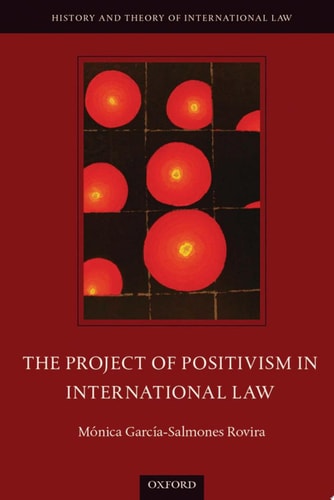
The Project of Positivism in International Law
0
0
As an Amazon Associate and affiliate partner, Menrva Books earns from qualifying purchases. Learn more
Author Description
International legal positivism has been crucial to the development of international law since the nineteenth century. It is often seen as the basis of mainstream or traditional international legal thought. The Project of Positivism in International Law addresses this theory in the long-standing tradition of critical intellectual histories of international law. It provides a nuanced analysis of the resilience of the economic-positivist theory, and shows how influential its role was in shaping the modern frameworks of international law. The book argues that the rise of positivist international law was inseparable from philosophical developments placing the notion of conflict of interests at the centre of collective life. Where previously international thought was dominated by notions of the right, the just, and the good, increasingly international relations became viewed as 'interests' in need of harmonisation. In this context, international law was re-founded as the universal law that could harmonise the interests of both public and private international entities. The book argues that these evolutions in philosophical thought were bound up with the consolidation of capitalism, and with the ideas about human existence and human nature which emerged in that process. It provides an innovative analysis of the selected biography of ideas which it presents, including a detailed focus on the work of Hans Kelsen, one of the leading positivist thinkers of the twentieth century. It also argues that the work of Lassa Oppenheim should be included within this analysis, as providing some of the key founding texts of positivism in international law. This book will be a fascinating read for scholars and students of international legal theory, historians of ideas, and legal philosophers.
Menrva's Summary
THE THESIS
This book investigates the historical and philosophical origins of international legal positivism to determine how it became the dominant framework for modern international law. Mónica García-Salmones Rovira, a scholar of legal theory, utilizes a critical intellectual history approach to examine the evolution of positivist thought. She argues that the rise of this legal tradition is inextricably linked to the emergence of capitalism and a philosophical shift that prioritized the harmonization of conflicting interests over traditional concepts of justice and morality.
THE SCOPE MAP
What You Will Find
- An analysis of the intellectual history of international legal positivism from the nineteenth century to the present.
- A detailed examination of the works of Hans Kelsen and Lassa Oppenheim as foundational figures.
- A critique of the economic-positivist theory and its role in shaping modern international legal frameworks.
Scope Limits
- The text does not provide a comprehensive survey of all international legal theories, focusing specifically on the positivist tradition.
- It does not offer a practical manual for legal practitioners, remaining strictly within the realm of theoretical and historical analysis.
THE AUTHORITY PERSPECTIVE
Scholars and legal historians frequently note the academic density and rigorous philosophical inquiry present throughout the text. Experts highlight this work as a significant contribution to the critical history of international law, particularly for its focus on the intersection of economic development and legal theory.
Page Count:
449
Publication Date:
2013-01-01
Publisher:
OUP Oxford
ISBN-10:
0191508314
ISBN-13:
9780191508318
International Law
Legal History
Professional Career & Trade
Intellectual History
Law Philosophy
Legal Theory