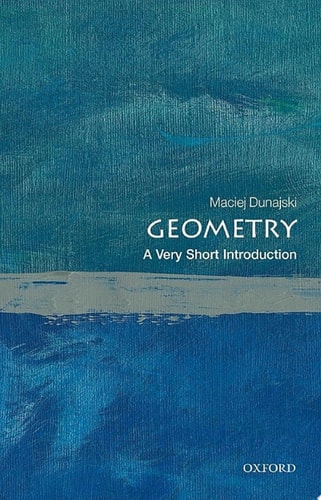
Geometry: A Very Short Introduction
0
0
As an Amazon Associate and affiliate partner, Menrva Books earns from qualifying purchases. Learn more
Author Description
The study of geometry is at least 2500 years old, and it is within this field that the concept of mathematical proof - deductive reasoning from a set of axioms - first arose. To this day geometry remains a very active area of research in mathematics. This Very Short Introduction covers the areas of mathematics falling under geometry, starting with topics such as Euclidean and non-Euclidean geometries, and ranging to curved spaces, projective geometry in Renaissance art, and geometry of space-time inside a black hole. Starting from the basics, Maciej Dunajski proceeds from concrete examples (of mathematical objects like Platonic solids, or theorems like the Pythagorean theorem) to general principles. Throughout, he outlines the role geometry plays in the broader context of science and art. Very Short Introductions: Brilliant, Sharp, Inspiring ABOUT THE SERIES: The Very Short Introductions series from Oxford University Press contains hundreds of titles in almost every subject area. These pocket-sized books are the perfect way to get ahead in a new subject quickly. Our expert authors combine facts, analysis, perspective, new ideas, and enthusiasm to make interesting and challenging topics highly readable.
Menrva's Summary
THE THESIS
This book investigates the fundamental principles of geometry, tracing its evolution from ancient deductive reasoning to its modern applications in theoretical physics. Maciej Dunajski, a reader in mathematical physics at the University of Cambridge, utilizes historical context and mathematical proofs to explain how geometric concepts transition from simple Euclidean shapes to complex, multidimensional spaces. The text argues that geometry serves as a bridge between abstract mathematical theory and the physical reality of the universe.
THE SCOPE MAP
What You Will Find
- Euclidean and non-Euclidean geometry frameworks
- Analysis of projective geometry in Renaissance art
- Mathematical properties of Platonic solids and the Pythagorean theorem
- Geometric applications in space-time and black hole theory
Scope Limits
- Does not provide exhaustive proofs for every theorem mentioned
- Does not serve as a comprehensive textbook for advanced university-level research
THE AUTHORITY PERSPECTIVE
Experts and readers frequently note the accessibility of the prose, which balances historical narrative with technical mathematical concepts. It is widely regarded as a concise, foundational overview suitable for students and interested laypeople seeking a structured introduction to the field.
Page Count:
176
Publication Date:
2022-01-01
Publisher:
OUP Oxford
ISBN-10:
0191506613
ISBN-13:
9780191506611
Science
Non-Fiction
Mathematics
Post-Calculus
Education
Mathematics Statistics
Geometry
Geometry-Junior Level