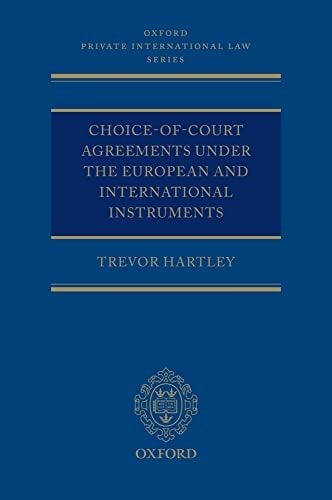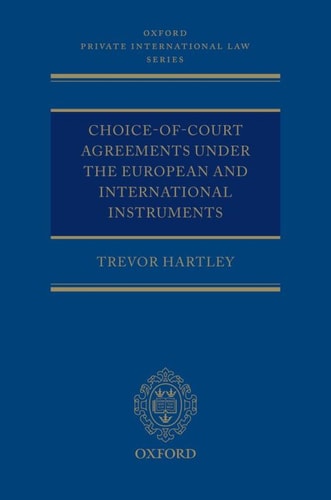
Choice-of-court Agreements under the European and International Instruments: The Revised Brussels I Regulation, the Lugano Convention, and the Hague Convention
0
0
As an Amazon Associate and affiliate partner, Menrva Books earns from qualifying purchases. Learn more
Author Description
This is the first text to address all the instruments that will govern choice-of-court agreements in Europe and to engage in a practical discussion of their mutual relationship. The existing common law, which has dominated discussion of this subject for so long, will become less significant as European and international instruments become more widely applicable. The consequences of this, both for practitioners and business persons engaging in international transactions, are explained by thematic chapters covering all major issues affected. The work opens with an introduction to the components of a choice-of-court agreement and to the origins, principles, and status of the various instruments, making the text accessible to a broad practitioner audience. The scope of the instruments - territorial application, international application and subject-matter application - as well as conflicts between them, are addressed in Part II, which is devoted to guidance on deciding which instrument applies. Validity (substantive and formal), effects, remedies, and procedure are discussed in Part III, while Part IV tackles a range of more specialist areas, including insurance, consumer contracts, employment contracts, companies, and intellectual property. Comprehensive appendices follow, including the Hague Convention 2005 in its entirety, alongside extracts from Brussels I and Lugano, making this a standalone support for any practitioner facing unfamiliar questions in the area.
Menrva's Summary
THE THESIS
How do the overlapping European and international legal instruments govern the validity and enforcement of choice-of-court agreements in cross-border transactions? Trevor C. Hartley, a recognized authority in private international law, provides a systematic analysis of the Revised Brussels I Regulation, the Lugano Convention, and the Hague Convention. The text moves beyond traditional common law frameworks to establish a modern methodology for practitioners navigating the complex interplay between these regional and global legal regimes.
THE SCOPE MAP
What You Will Find
- Comparative analysis of the Revised Brussels I Regulation, Lugano Convention, and Hague Convention.
- Methodological guidance for determining which instrument applies to specific international disputes.
- Detailed examination of substantive and formal validity, procedural remedies, and jurisdictional effects.
- Specialized application chapters for insurance, consumer, employment, corporate, and intellectual property law.
Scope Limits
- The text focuses primarily on the specified European and international instruments rather than exhaustive analysis of domestic common law precedents.
- It does not cover non-contractual jurisdictional disputes outside the scope of choice-of-court agreements.
THE AUTHORITY PERSPECTIVE
Legal practitioners and scholars identify this work as a primary reference for navigating the transition from common law dominance to codified international instruments. Readers frequently note the clarity of the author's thematic approach, which simplifies the dense procedural requirements inherent in cross-border litigation.
Page Count:
546
Publication Date:
2013-01-01
Publisher:
OUP Oxford
ISBN-10:
0191503231
ISBN-13:
9780191503238
International Law
Reference
Commercial law
Professional Career & Trade
European Law
Law
Community Tags
Similar Books