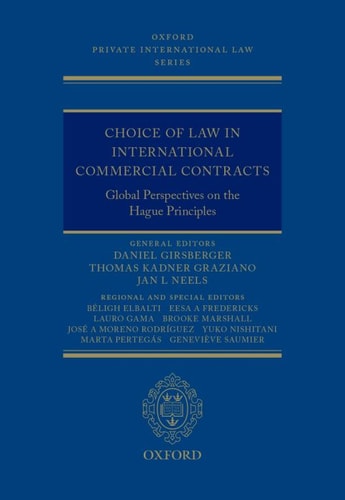
Choice of Law in International Commercial Contracts
0
0
As an Amazon Associate and affiliate partner, Menrva Books earns from qualifying purchases. Learn more
Author Description
Although the possibility of making a choice of law in respect of international commercial contracts has become widely accepted, national law still diverges in many respects with regard to the scope and relevance of, and the limitations on, party autonomy, leading to uncertainty in international commercial relations. This book compares the Hague Principles on Choice of Law in International Commercial Contracts (2015) with national, regional, supranational, and international rules on choice of law around the world in order to chronicle the divergent approaches which exist today. The work is introduced by a comprehensive comparative report which sets out the similarities and differences between the featured national, regional, supranational, and international rules, comparing such rules with those of the Hague Principles, thereby initiating a discussion on further harmonization in the field. Another report focuses on the application of the Hague Principles in the context of international commercial arbitration. Dedicated chapters analyse the Hague Principles from a historical, theoretical, and international organizational point of view. Finally, examining each jurisdiction in detail, the book presents sixty national and regional article-by-article commentaries on the Hague Principles written by experts from all parts of the world. This dedicated and in-depth global comparative study of national, regional, supranational, and international rules provides a definitive reference guide to the key principles in respect of choice of law for international commercial contracts.
Menrva's Summary
THE THESIS
This book investigates the extent to which national legal systems diverge regarding party autonomy in international commercial contracts and evaluates the potential for global harmonization through the Hague Principles. The authorial team, comprised of international legal experts, utilizes a comparative methodology to analyze how various jurisdictions interpret choice of law rules. By contrasting the 2015 Hague Principles against a wide array of national, regional, and supranational frameworks, the text establishes a structured argument for the necessity of standardized legal practices in international commerce.
THE SCOPE MAP
What You Will Find
- Comparative analysis of the 2015 Hague Principles on Choice of Law in International Commercial Contracts.
- Sixty individual national and regional article-by-article commentaries.
- Examination of choice of law applications within international commercial arbitration.
- Historical and theoretical perspectives on international organizational law.
Scope Limits
- The text does not provide a comprehensive analysis of domestic contract law outside the specific context of choice of law provisions.
- It does not cover non-commercial or consumer-specific contract litigation.
THE AUTHORITY PERSPECTIVE
Legal scholars and practitioners identify this work as a primary reference for understanding the global landscape of private international law. Experts frequently note the high level of academic density and the utility of the multi-jurisdictional commentaries for comparative research.
Page Count:
1350
Publication Date:
2021-01-01
Publisher:
OUP Oxford
ISBN-10:
0192576410
ISBN-13:
9780192576415
Contract law
Reference
Commercial law
Law
International Law
Professional Career & Trade
Community Tags
Similar Books