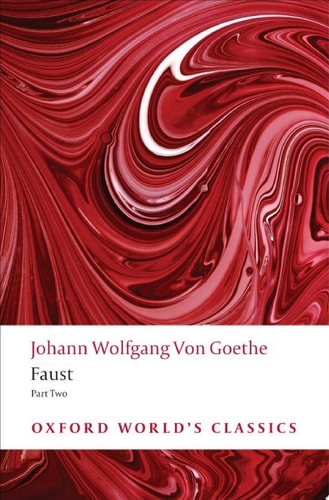
Faust: Part Two
0
0
As an Amazon Associate and affiliate partner, Menrva Books earns from qualifying purchases. Learn more
Author Description
Loosely connected with Part One and the German legend of Faust, Part Two is a dramatic epic rather than a strictly constructed drama. It is conceived as an act of homage to classical Greek culture and inspired above all by the world of story-telling and myth at the heart of the Greek tradition, as well as owing some of its material to the Arabian Nights tales. The restless and ruthless hero, advised by his cynical demon-companion Mephistopheles, visits classical Greece i search of the beautiful Helen of Troy. Returning to modern times, he seeks to crown his career by gaining control of the elements, and at his death is carried up into the unkown regions, still in pursuit of the `Eternal Feminine'. David Luke's translation of Part One won the European Poetry Translation Prize. Here he again imitates the varied verse-forms of the original, and provides a highly readable - and actable - translation, supported by an introduction, full notes, and an index of classical mythology. ABOUT THE SERIES: For over 100 years Oxford World's Classics has made available the widest range of literature from around the globe. Each affordable volume reflects Oxford's commitment to scholarship, providing the most accurate text plus a wealth of other valuable features, including expert introductions by leading authorities, helpful notes to clarify the text, up-to-date bibliographies for further study, and much more.
Menrva's Summary
THE PULSE
Faust continues his restless pursuit of knowledge and experience, moving from the medieval setting of the first part into a grand, mythic landscape where he seeks to possess the ideal of beauty. Following his pact with the demon Mephistopheles, Faust navigates a series of allegorical and historical encounters that span from the imperial court to the realm of classical antiquity. The narrative functions as a dramatic epic, prioritizing symbolic exploration over linear plot progression. Faust operates within a world governed by shifting mythological frameworks and philosophical inquiry, constantly pushed forward by his insatiable desire to transcend human limitations. The text utilizes a variety of verse forms to mirror the expansive and often surreal nature of the protagonist's experiences.
INSIDE THE PAGES
- Integration of classical Greek mythology and figures
- Use of varied, complex verse forms
- Allegorical representation of historical and cultural eras
- Exploration of the 'Eternal Feminine' as a thematic anchor
- Episodic structure that departs from traditional dramatic unity
- Inclusion of scholarly introduction and extensive notes
- Philosophical dialogue regarding power, nature, and human ambition
- Stylistic homage to both European and Eastern storytelling traditions
THE COLLECTIVE ECHO
Readers and critics often characterize this work as a dense, challenging departure from the more grounded narrative of the first part. Discussion frequently centers on the shift toward high-concept allegory and the sheer scale of the mythological references embedded within the verse. Many observers highlight the translation's success in maintaining the rhythmic variety of the original German, which is essential for navigating the play's tonal shifts. While some find the episodic nature difficult to track, others appreciate the ambition of the work as a summation of Goethe's philosophical and aesthetic concerns. The text is widely regarded as a significant, if demanding, conclusion to the Faustian legend.
Page Count:
383
Publication Date:
1994-01-01
Publisher:
OUP Oxford
ISBN-10:
0191500453
ISBN-13:
9780191500459
Poetry
Drama
Mythology
Classic Literature
Epic
English
German
English & College Success
Community Tags
Similar Books