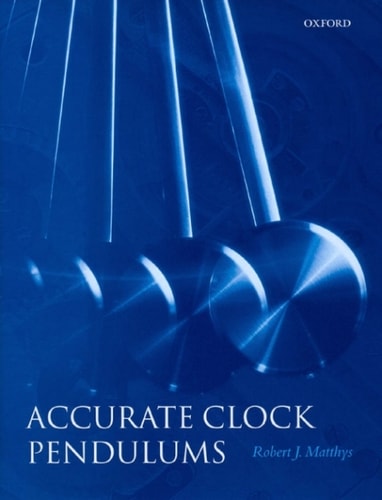
Accurate Clock Pendulums
0
0
As an Amazon Associate and affiliate partner, Menrva Books earns from qualifying purchases. Learn more
Author Description
The Shortt clock, made in the 1920s, is the most famous accurate clock pendulum ever known, having an accuracy of one second per year when kept at nearly constant temperature. Almost all of a pendulum clock's accuracy resides in its pendulum. If the pendulum is accurate, the clock will be accurate. In this book, the author describes many scientific aspects of pendulum design and operation in simple terms with experimental data, and little mathematics. It has been written, looking at all the different parts and aspects of the pendulum in great detail, chapter by chapter, reflecting the degree of attention necessary for making a pendulum run accurately. The topics covered include the dimensional stability of different pendulum materials, good and poor suspension spring designs, the design of mechanical joints and clamps, effect of quartz on accuracy, temperature compensation, air drag of different bob shapes and making a sinusoidal electromagnetic drive. One whole chapter is devoted to simple ways of improving the accuracy of ordinary low-cost pendulum clocks, which have a different construction compared to the more expensive designs of substantially well-made ones. This book will prove invaluable to anyone who wants to know how to make a more accurate pendulum or pendulum clock.
Menrva's Summary
THE THESIS
This book investigates the mechanical and physical principles required to achieve high-precision timekeeping through the design and optimization of pendulum systems. Robert James Matthys, an expert in precision instrumentation, draws upon experimental data and engineering analysis to explain how material stability, suspension mechanics, and environmental factors dictate the accuracy of a clock. The text provides a practical framework for both hobbyists and serious horologists to improve pendulum performance without relying on complex mathematical derivations.
THE SCOPE MAP
What You Will Find
- Analysis of dimensional stability in various pendulum materials
- Evaluation of suspension spring designs and mechanical joints
- Methods for temperature compensation and air drag reduction
- Techniques for constructing sinusoidal electromagnetic drives
- Practical modifications for improving low-cost pendulum clocks
Scope Limits
- Does not provide an exhaustive history of horology beyond the Shortt clock
- Avoids advanced theoretical physics or complex calculus in favor of practical application
THE AUTHORITY PERSPECTIVE
Experts and hobbyists frequently cite this work as a primary resource for understanding the physical variables that influence pendulum accuracy. Readers note that the author successfully translates complex engineering concepts into accessible, actionable instructions for clock construction and modification.
Page Count:
280
Publication Date:
2004-01-01
Publisher:
Oxford University Press
ISBN-10:
0191513687
ISBN-13:
9780191513688
Science
Pendulum
Clock And Watch Making
Technology
Professional Career & Trade
Reference
Engineering
Horology
Community Tags
Similar Books