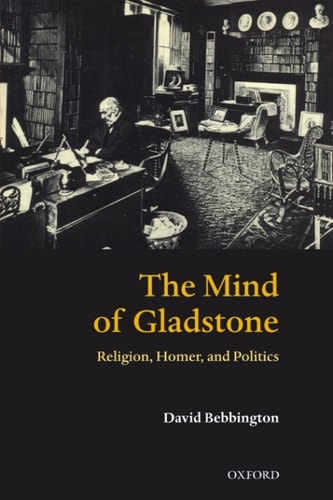
The Mind of Gladstone: Religion, Homer, and Politics
0
0
As an Amazon Associate and affiliate partner, Menrva Books earns from qualifying purchases. Learn more
Author Description
Gladstone's ideas are far more accessible for analysis now that, following the publication of his diaries, a record of his reading is available. This book traces the evolution of what the diaries reveal as the statesman's central intellectual preoccupations, theology and classical scholarship, as well as the groundwork of his early Conservatism and his mature Liberalism. In particular it examines the ideological sources of Gladstone's youthful opposition to reform before scrutinizing his convictions in theology. These are shown to have passed through more stages than has previously been supposed: he moved from Evangelicalism to Orthodox High Churchmanship, on to Tractarianism and then further to a broader stance that eventually crystallized as a liberal Catholicism. His classical studies, focused primarily on Homer, also changed over time, from a version that was designed to defend a traditional worldview to an approach that exalted the depiction of human endeavour in the ancient Greek poet. An enduring principle of his thought about religion and antiquity was the importance of community, but a fresh axiom that arose from the modifications of his views was the centrality of all that was human. The twin values of community and humanity are shown to have conditioned Gladstone's rhetoric as Liberal leader, so making him, in terms of recent political thought, a communitarian rather than a liberal, but one with a distinctive humanitarian message. As a result of a thorough scrutiny of Gladstone's private papers, the Victorian statesman is shown to have derived a distinctive standpoint from the Christian and classical sources of his thinking and so to have left an enduring intellectual legacy. It becomes apparent that his religion, Homeric studies and political thought were interwoven in unexpected ways. The evolution of Gladstone's central intellectual preoccupations, with religion and Homer, is the theme of this book. It shows how the statesman developed from Evangelism
Menrva's Summary
THE THESIS
This book investigates how the intellectual development of William Ewart Gladstone was shaped by the intersection of his religious convictions, classical scholarship, and political ideology. David W. Bebbington, a historian specializing in Victorian intellectual life, utilizes Gladstone's personal diaries and private papers to map the evolution of his thought. The author argues that Gladstone's transition from early Conservatism to mature Liberalism was fundamentally driven by his shifting theological stances and his deep engagement with Homeric studies. By analyzing these primary sources, the text demonstrates that Gladstone's political rhetoric was rooted in a distinct synthesis of Christian and classical values.
THE SCOPE MAP
What You Will Find
- An analysis of Gladstone's theological progression from Evangelicalism to High Churchmanship and liberal Catholicism.
- A study of Gladstone's Homeric scholarship and its role in defending his worldview.
- An examination of the link between communitarian values and Victorian political rhetoric.
Scope Limits
- The text does not provide a comprehensive biography of Gladstone's entire life or career.
- It does not focus on the day-to-day legislative mechanics of the Victorian Parliament.
THE AUTHORITY PERSPECTIVE
Scholars and historians recognize this work as a significant contribution to the understanding of Victorian intellectual history. Readers frequently note the academic density of the prose and the meticulous use of primary source material to reframe Gladstone's political legacy.
Page Count:
352
Publication Date:
2004-01-01
Publisher:
OUP Oxford
ISBN-10:
0191514888
ISBN-13:
9780191514883
History
Biography
European History
Intellectual History
Religion
Theology
Homer
Community Tags
Similar Books