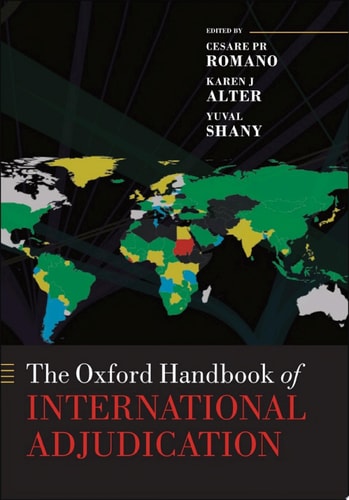
The Oxford Handbook of International Adjudication
0
0
As an Amazon Associate and affiliate partner, Menrva Books earns from qualifying purchases. Learn more
Author Description
The post-Cold War proliferation of international adjudicatory bodies and increase in litigation has greatly affected international law and politics. A growing number of international courts and tribunals, exercising jurisdiction over international crimes and sundry international disputes, have become, in some respects, the lynchpin of the international legal system. The Oxford Handbook of International Adjudication charts the transformations in international adjudication that took place astride the twentieth and twenty-first century, bringing together the insight of 47 prominent legal, philosophical, ethical, political, and social science scholars. Overall, the 40 contributions in this Handbook provide an original and comprehensive understanding of the various contemporary forms of international adjudication. The Handbook is divided into six parts. Part I provides an overview of the origins and evolution of international adjudicatory bodies, from the nineteenth century to the present, highlighting the dynamics driving the multiplication of international adjudicative bodies and their uneven expansion. Part II analyses the main families of international adjudicative bodies, providing a detailed study of state-to-state, criminal, human rights, regional economic, and administrative courts and tribunals, as well as arbitral tribunals and international compensation bodies. Part III lays out the theoretical approaches to international adjudication, including those of law, political science, sociology, and philosophy. Part IV examines some contemporary issues in international adjudication, including the behavior, role, and effectiveness of international judges and the political constraints that restrict their function, as well as the making of international law by international courts and tribunals, the relationship between international and domestic adjudicators, the election and selection of judges, the development of judicial ethical standards, and the financing of international courts.
Menrva's Summary
THE THESIS
This volume investigates the rapid proliferation of international adjudicatory bodies and their evolving role as central pillars within the global legal and political landscape. Edited by Cesare P. R. Romano, Karen Alter, and Yuval Shany, the work synthesizes contributions from 47 scholars across law, philosophy, and social sciences. It provides a comprehensive framework for understanding how these institutions function, how they have expanded since the late twentieth century, and the political constraints that shape their effectiveness.
THE SCOPE MAP
What You Will Find
- Historical evolution of international courts and tribunals from the nineteenth century to the present
- Categorization of adjudicative bodies including state-to-state, criminal, human rights, and regional economic courts
- Theoretical perspectives from legal, sociological, and political science disciplines
- Analysis of judicial behavior, selection processes, and ethical standards
Scope Limits
- Does not provide exhaustive case law summaries for every individual dispute
- Does not focus on domestic litigation outside of its relationship with international adjudicators
THE AUTHORITY PERSPECTIVE
Experts and legal scholars frequently cite this work as a foundational reference for understanding the institutional mechanics of international law. Readers often note the academic density of the prose, which is tailored for practitioners, researchers, and advanced students in the field.
Page Count:
1072
Publication Date:
2014-01-01
Publisher:
OUP Oxford
ISBN-10:
0191511420
ISBN-13:
9780191511424
International relations
International Law
Professional Career & Trade
Reference
Law
Academic
Community Tags
Similar Books







Reader Comments
Share Your Thoughts
No comments yet. Be the first to share your thoughts!