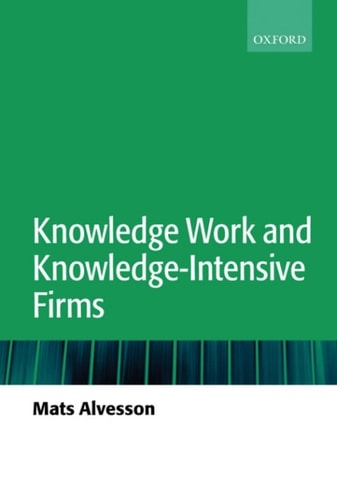
Knowledge Work and Knowledge-Intensive Firms
0
0
As an Amazon Associate and affiliate partner, Menrva Books earns from qualifying purchases. Learn more
Author Description
The book addresses the concept of knowledge in a work and organizational context, professional or knowledge work, and knowledge-intensive firms. It provides a critical, moderate social constructivist understanding of these themes and the current interest in knowledge management, organization and the "knowledge economy". Professional service as well as science and high-tech work and firms are treated, reporting case studies of IT and management consultancy firms, advertising agencies and life science based companies. The concepts of knowledge and knowledge management are discussed and dominant functionalist thinking debunked. The ambiguity of knowledge in the input, process and output of professional work is emphasized. It is suggested that we should be careful in assuming too much about the nature, role and effects of "knowledge" in business life and instead take the constructed nature of knowledge seriously and scrutinize knowledge claims. Knowledge talk and claims may frequently be key elements in marketing and identity work as much as they inform us about key activities of professionals and knowledge-intensive firms. The book covers a fairly broad set of management, organization and working life aspects are addressed, including HRM themes and different forms of control including client control and regulation of identity. From a perspective emphasizing the ambiguity of social and business life, rhetoric, symbolism, image, politics of knowledge claims, identity and identity work are viewed as crucial for the understanding and management of professional/knowledge work and organizations. The book is provocative and challenges key assumptions in dominant knowledge and organization thinking, suggesting a novel theoretical approach. The book is intended for third year level undergraduates upwards, and aims to say things also of relevance for scholars. It mixes textbook and research ambitions.
Menrva's Summary
THE THESIS
This book investigates the nature of knowledge within organizational contexts, challenging the functionalist assumptions that dominate contemporary discourse on the knowledge economy. Mats Alvesson, a professor known for his critical approach to organizational studies, utilizes a social constructivist framework to analyze how knowledge is defined, marketed, and managed in professional service firms. He argues that 'knowledge' is often a symbolic construct used for identity work and organizational image rather than a purely objective input or output of professional labor.
THE SCOPE MAP
What You Will Find
- Analysis of knowledge-intensive firms including IT, management consultancy, advertising, and life sciences.
- Examination of HRM practices, client control mechanisms, and identity regulation.
- Theoretical critique of functionalist management models.
Scope Limits
- The text does not provide a prescriptive 'how-to' guide for implementing knowledge management systems.
- It does not offer a singular, unified definition of knowledge, focusing instead on its inherent ambiguity.
THE AUTHORITY PERSPECTIVE
Scholars and students frequently note the text's critical, provocative stance, which serves as a counterpoint to mainstream management literature. Experts highlight this as a foundational text for those seeking to understand the sociological complexities and rhetorical dimensions of professional work environments.
Page Count:
271
Publication Date:
2004-01-01
Publisher:
Oxford University Press, USA
ISBN-10:
0191514985
ISBN-13:
9780191514982
Business
Sociology of Work
Organizational Theory
Special Topics
Management
Community Tags
Other Editions(2)
Similar Books












Reader Comments
Share Your Thoughts
No comments yet. Be the first to share your thoughts!