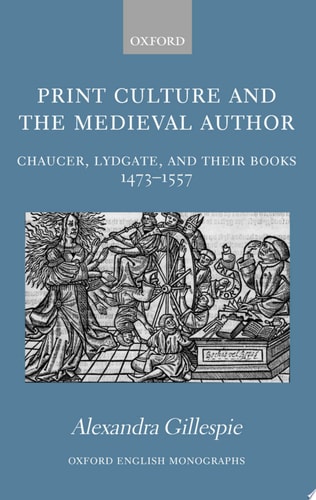
Print Culture and the Medieval Author: Chaucer, Lydgate, and Their Books 1473-1557
0
0
As an Amazon Associate and affiliate partner, Menrva Books earns from qualifying purchases. Learn more
Author Description
Print Culture and the Medieval Author is a book about books. Examining hundreds of early printed books and their late medieval analogues, Alexandra Gillespie writes a bibliographical history of the poet Geoffrey Chaucer and his follower John Lydgate in the century after the arrival of printing in England. Her study is an important new contribution to the emerging 'sociology of the text' in English literary and historical studies. At the centre of this study is a familiar question: what is an author? The idea of the vernacular writer was already contested and unstable in medieval England; Gillespie demonstrates that in the late Middle Ages it was also a way for book producers and readers to mediate the risks - commercial, political, religious, and imaginative - involved in the publication of literary texts. Gillespie's discussion focuses on the changes associated with the shift to print, scribal precedents for these changes, and contemporary understanding of them. The treatment of texts associated with Chaucer and Lydgate is an index to the sometimes flexible, sometimes resistant responses of book printers, copyists, decorators, distributors, patrons, censors, owners, and readers to a gradual but profoundly influential bibliographical transition. The research is conducted across somewhat intractable boundaries. Gillespie writes about medieval and modern history; about manuscript and print; about canonical and marginal authors; about literary works and books as objects. In the process, she finds new meanings for some medieval vernacular texts and a new place for some old books in a history of English culture.
Menrva's Summary
THE THESIS
This work investigates how the transition from manuscript to print culture in England between 1473 and 1557 redefined the concept of the author and the production of vernacular texts. Alexandra Gillespie, a scholar in medieval and early modern studies, utilizes a bibliographical history approach to analyze the physical books of Geoffrey Chaucer and John Lydgate. She argues that the shift to print was not merely a technological change but a complex negotiation of commercial, political, and religious risks by producers and readers alike.
THE SCOPE MAP
What You Will Find
- Bibliographical analysis of early printed books and their late medieval manuscript analogues
- Examination of the 'sociology of the text' within the English literary tradition
- Historical investigation into the roles of printers, copyists, decorators, and censors
- Comparative study of canonical and marginal literary works
Scope Limits
- The study is strictly bounded by the years 1473 to 1557
- Focus is limited to the specific literary legacies of Chaucer and Lydgate
THE AUTHORITY PERSPECTIVE
Scholars recognize this text as a significant contribution to the sociology of the text and the history of the book in England. Readers frequently note the academic density of the prose and the meticulous nature of the bibliographical research presented.
Page Count:
296
Publication Date:
2007-01-01
Publisher:
Oxford University Press
ISBN-10:
0191514659
ISBN-13:
9780191514654
History
English & College Success
Print Culture
English literature
English
Bibliography
Literary Criticism
Community Tags
Similar Books