An Age of Transition?: Economy and Society in England in the Later Middle Ages
0
0
As an Amazon Associate and affiliate partner, Menrva Books earns from qualifying purchases. Learn more
Author Description
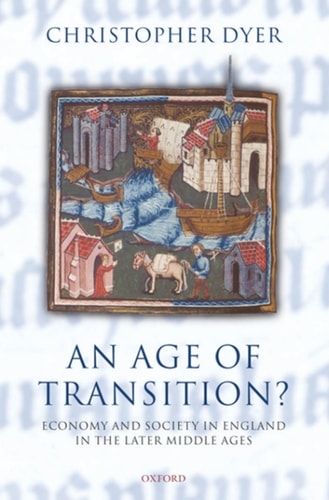
This significant new work by a prominent medievalist focusses on the period of transition between 1250 and 1550, when the wealth and power of the great lords was threatened and weakened, and when new social groups emerged and new methods of production were adopted. Professor Dyer examines both the commercial growth of the thirteenth century, and the restructuring of farming, trade, and industry in the fifteenth. The subjects investigated include the balance between individuals and the collective interests of families and villages. The role of the aristocracy and in particular the gentry are scrutinized, and emphasis placed on the initiatives taken by peasants, traders, and craftsmen. The growth in consumption moved the economy in new directions after 1350, and this encouraged investment in productive enterprises. A commercial mentality persisted and grew, and producers, such as farmers, profited from the market. Many people lived on wages, but not enough of them to justify describing the sixteenth century economy as capitalist. The conclusions are supported by research in sources not much used before, such as wills, and non-written evidence, including buildings. Christopher Dyer, who has already published on many aspects of this period, has produced the first full-length study by a single author of the 'transition'. He argues for a reassessment of the whole period, and shows that many features of the sixteenth, seventeenth, and eighteenth centuries can be found before 1500.
Menrva's Summary
THE THESIS
This work investigates whether the period between 1250 and 1550 in England represents a distinct era of transition characterized by the decline of traditional aristocratic power and the emergence of new economic and social structures. Christopher Dyer, a prominent medievalist, utilizes a combination of traditional archival research and under-utilized sources such as wills and architectural evidence to challenge existing periodization. He argues that the foundations of later economic developments were firmly established well before 1500, necessitating a reassessment of the transition from medieval to early modern society.
THE SCOPE MAP
What You Will Find
- Analysis of economic shifts in farming, trade, and industry from 1250 to 1550.
- Examination of social mobility among peasants, traders, and craftsmen.
- Investigation into the role of the gentry and the decline of great lords.
- Use of non-written evidence including buildings and material culture.
Scope Limits
- The study focuses primarily on England rather than continental Europe.
- It does not classify the sixteenth-century economy as fully capitalist, despite noting wage-labor growth.
THE AUTHORITY PERSPECTIVE
Experts recognize this text as a significant contribution to medieval economic history due to its comprehensive scope and use of diverse source materials. Readers frequently note the academic density of the prose, which is intended for scholars and students of the period.
Page Count:
300
Publication Date:
2005-01-01
Publisher:
Oxford University Press
ISBN-10:
0191518824
ISBN-13:
9780191518829
History
Academic
European History
Great Britain
Economic History
Social History
England
Community Tags
Similar Books