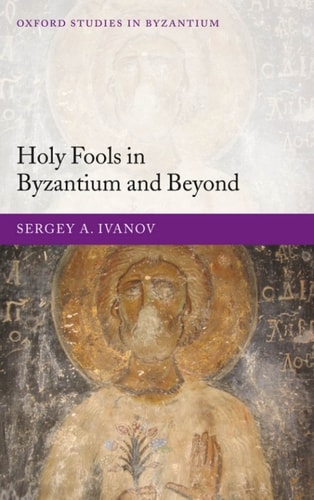
Holy Fools in Byzantium and Beyond
0
0
As an Amazon Associate and affiliate partner, Menrva Books earns from qualifying purchases. Learn more
Author Description
There are saints in Orthodox Christian culture who overturn the conventional concept of sainthood. Their conduct may be unruly and salacious, they may blaspheme and even kill - yet, mysteriously, those around them treat them with even more reverence. Such saints are called 'holy fools'. In this pioneering study Sergey A. Ivanov examines the phenomenon of holy foolery from a cultural standpoint. He identifies its prerequisites and its development in religious thought, and traces the emergence of the first hagiographic texts describing these paradoxical saints. He describes the beginnings of holy foolery in Egyptian monasteries of the fifth century, followed by its high point in the cities of Byzantium, with an eventual decline in the twelfth to fourteenth centuries. He also compares the important Russian tradition of holy fools, which in some form has survived to this day.
Menrva's Summary
THE THESIS
This study investigates the origins, cultural development, and theological paradox of the 'holy fool' phenomenon within Orthodox Christian tradition. Sergey A. Ivanov, a scholar of Byzantine culture, utilizes a rigorous historical and literary framework to analyze how these figures—who often exhibited transgressive or erratic behavior—were integrated into the canon of sainthood. By examining early hagiographic texts and monastic records, the author argues that holy foolery served as a distinct, albeit challenging, expression of religious devotion that evolved significantly from its Egyptian roots to its later manifestations in Byzantium and Russia.
THE SCOPE MAP
What You Will Find
- Analysis of the emergence of holy foolery in fifth-century Egyptian monasteries.
- Examination of the high point of the tradition within Byzantine urban centers.
- Comparative study of the Russian tradition of holy fools and its historical longevity.
- Evaluation of early hagiographic texts and their role in shaping the perception of these saints.
Scope Limits
- The text does not provide a comprehensive theological defense of the actions of holy fools.
- The analysis focuses primarily on the cultural and historical development rather than contemporary psychological interpretations.
THE AUTHORITY PERSPECTIVE
Scholars and historians frequently cite this work as a foundational text for understanding the complexities of Byzantine hagiography and religious social norms. Readers often note the academic density of the prose, which provides a thorough and well-documented exploration of a niche but significant religious phenomenon.
Page Count:
479
Publication Date:
2006-01-01
Publisher:
Oxford University Press
ISBN-10:
0191515140
ISBN-13:
9780191515149
Religion
History
Orthodox Christianity
Hagiography
Byzantine History
Community Tags
Similar Books