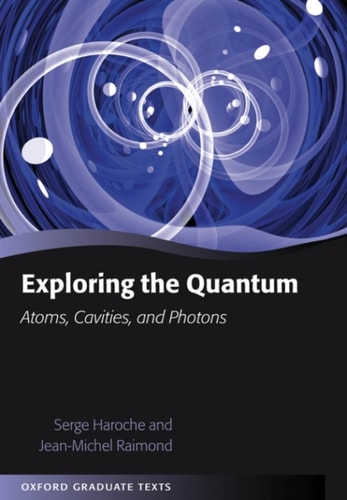
Exploring the Quantum: Atoms, Cavities, and Photons
0
0
As an Amazon Associate and affiliate partner, Menrva Books earns from qualifying purchases. Learn more
Author Description
The counter-intuitive aspects of quantum physics have been long illustrated by thought experiments, from Einstein's photon box to Schrödinger's cat. These experiments have now become real, with single particles - electrons, atoms, or photons - directly unveiling the strange features of the quantum. State superpositions, entanglement and complementarity define a novel quantum logic which can be harnessed for information processing, raising great hopes for applications. This book describes a class of such thought experiments made real. Juggling with atoms and photons confined in cavities, ions or cold atoms in traps, is here an incentive to shed a new light on the basic concepts of quantum physics. Measurement processes and decoherence at the quantum-classical boundary are highlighted. This volume, which combines theory and experiments, will be of interest to students in quantum physics, teachers seeking illustrations for their lectures and new problem sets, researchers in quantum optics and quantum information.
Menrva's Summary
THE THESIS
This text investigates the transition of quantum mechanical thought experiments into observable physical realities through the manipulation of single atoms, cavities, and photons. Authors Jean-Michel Raimond and Serge Haroche, both distinguished researchers in the field of quantum optics, utilize their extensive experimental background to bridge the gap between theoretical quantum logic and practical laboratory implementation. The book provides a rigorous framework for understanding how state superpositions and entanglement function within controlled environments.
THE SCOPE MAP
What You Will Find
- Detailed analysis of quantum measurement processes and decoherence at the quantum-classical boundary.
- Methodologies for confining atoms and photons within high-finesse cavities.
- Theoretical foundations of quantum information processing and logic.
Scope Limits
- The text assumes a high level of prior knowledge in quantum mechanics and does not serve as an introductory primer for laypeople.
- It focuses specifically on cavity quantum electrodynamics rather than broader applications of quantum computing.
THE AUTHORITY PERSPECTIVE
Experts and academics frequently cite this volume as a foundational text for graduate-level study in quantum optics and experimental physics. Readers often note the high density of the prose, which requires a strong mathematical and physical background to fully comprehend the experimental setups described.
Page Count:
616
Publication Date:
2006-01-01
Publisher:
OUP Oxford
ISBN-10:
0191523240
ISBN-13:
9780191523243
Science
Physics
Academic
Earth Sciences
Quantum optics
Community Tags
Similar Books