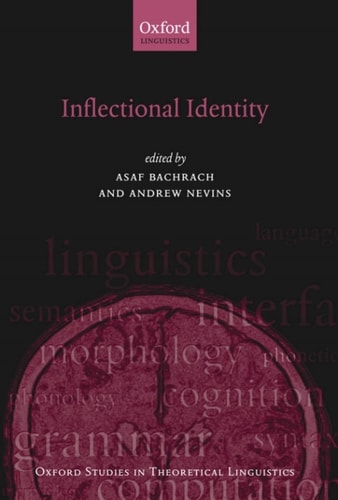
Inflectional Identity
0
0
As an Amazon Associate and affiliate partner, Menrva Books earns from qualifying purchases. Learn more
Author Description
A recurrent issue in linguistic theory and psychology concerns the cognitive status of memorized lists and their internal structure. In morphological theory, the collections of inflected forms of a given noun, verb, or adjective into inflectional paradigms are thought to constitute one such type of list. This book focuses on the question of which elements in a paradigm can stand in a relation of partial or total phonological identity. Leading scholars consider inflectional identity from a variety of theoretical perspectives, with an emphasis on both case studies and predictive theories of where syncretism and other "paradigmatic pressures" will occur in natural language. The authors consider phenomena such as allomorphy and syncretism while exploring questions of underlying representations, the formal properties of markedness, and the featural representation of conjugation and declension classes. They do so from the perspective of contemporary theories of morphology and phonology, including Distributed Morphology and Optimality Theory, and in the context of a wide range of languages, among them Amharic, Greek, Romanian, Russian, Saami, and Yiddish. The subjects addressed in the book include the role of featural decomposition of morphosyntactic features, the status of paradigms as the unit of syncretism, asymmetric effects in identity-dependence, and the selection of a base-of-derivation. The Bases of Inflectional Identity will interest linguists and cognitive scientists, especially students and scholars of phonological theory and the phonology-morphology and mind-language interfaces at graduate level and above.
Menrva's Summary
THE THESIS
This book investigates the cognitive status and internal structure of inflectional paradigms, specifically focusing on the conditions under which elements within these paradigms exhibit phonological identity. The author and contributors examine how inflected forms of nouns, verbs, and adjectives are stored and processed, utilizing contemporary frameworks such as Distributed Morphology and Optimality Theory. By analyzing syncretism and allomorphy across diverse languages, the text seeks to establish predictive models for paradigmatic pressures and the formal properties of markedness.
THE SCOPE MAP
What You Will Find
- Analysis of morphosyntactic feature decomposition and featural representation of conjugation and declension classes.
- Theoretical application of Distributed Morphology and Optimality Theory to inflectional systems.
- Comparative case studies across languages including Amharic, Greek, Romanian, Russian, Saami, and Yiddish.
Scope Limits
- The text does not provide an introductory overview of general linguistics, assuming a high level of prior knowledge in phonology and morphology.
- It does not cover historical language evolution outside the context of synchronic paradigmatic identity.
THE AUTHORITY PERSPECTIVE
Experts identify this volume as a specialized resource for graduate-level researchers in theoretical linguistics and cognitive science. Readers frequently note the high academic density of the prose and the rigorous technical focus on the phonology-morphology interface.
Page Count:
382
Publication Date:
2008-01-01
Publisher:
Oxford University Press, U.S.A.
ISBN-10:
0191527440
ISBN-13:
9780191527449
English & College Success
Theoretical Linguistics
Morphology
Academic
English
Phonology
Linguistics
Community Tags
Similar Books