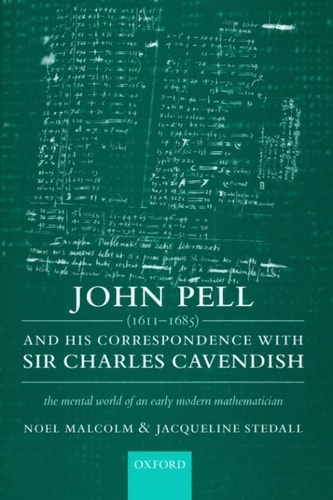
John Pell (1611-1685) and His Correspondence with Sir Charles Cavendish: The Mental World of an Early Modern Mathematician
0
0
As an Amazon Associate and affiliate partner, Menrva Books earns from qualifying purchases. Learn more
Author Description
The mathematician John Pell was a member of that golden generation of scientists Boyle, Wren, Hooke, and others which came together in the early Royal Society. Although he left a huge body of manuscript materials, he has remained an extraordinarily neglected figure, whose papers have never been properly explored. This book, the first ever full-length study of Pell, presents an in-depth account of his life and mathematical thinking, based on a detailed study of his manuscripts. It not only restores to his proper place in history a figure who was one of the leading mathematicians of his day; it also brings to life a strange, appealing, but awkward character, whose failure to publish his discoveries was caused by powerful scruples. In addition, this book shows that the range of Pell's interests extended far beyond mathematics. He was a key member of the circle of the 'intelligencer' Samuel Hartlib; he prepared translations of works by Descartes and Comenius; in the 1650s he served as Cromwell's envoy to Switzerland; and in the last part of his life he was an active member of the Royal Society, interested in the whole range of its activities. The study of Pell's life and thought thus illuminates many different aspects of 17th-century intellectual life. The book is in three parts. The first is a detailed biography of Pell; the second is an extended essay on his mathematical work; the third is a richly annotated edition of his correspondence with Sir Charles Cavendish. This correspondence, which has often been cited by scholars but has never been published in full, is concerned not only with mathematics but also with optics, philosophy, and many other subjects; conducted mainly while Pell was in the Netherlands and Cavendish was also on the Continent, it is an unusually fascinating example of the correspondence that flourished in the 17th-century 'Republic of letters'. This book will be an essential resource not only for historians of mathematics, science, and philosophy,
Menrva's Summary
THE THESIS
This study investigates the life and intellectual contributions of John Pell, a significant yet overlooked 17th-century mathematician, to determine his role within the early Royal Society and the broader Republic of Letters. Authors Jacqueline A. Stedall and Noel Malcolm utilize extensive archival research and previously unpublished manuscript materials to reconstruct Pell's career, mathematical methodology, and his complex personal and professional relationships. By analyzing his correspondence with Sir Charles Cavendish, the authors argue that Pell’s failure to publish was driven by specific intellectual scruples rather than a lack of capability, thereby repositioning him as a central figure in early modern scientific discourse.
THE SCOPE MAP
What You Will Find
- A comprehensive biographical account of John Pell’s life and career.
- An analytical essay detailing Pell’s mathematical theories and contributions.
- A fully annotated edition of the correspondence between John Pell and Sir Charles Cavendish.
- Insights into the intellectual circle of Samuel Hartlib and the Royal Society.
Scope Limits
- The book focuses primarily on the period of the 17th century and does not provide a broad survey of mathematics beyond Pell's specific sphere of influence.
- It does not attempt to provide a general history of the Royal Society, but rather uses Pell as a lens to view its activities.
THE AUTHORITY PERSPECTIVE
Scholars and historians of science recognize this work as a definitive resource for understanding the intellectual landscape of the 17th century. Readers frequently note the academic density of the prose and the meticulous nature of the archival transcriptions provided.
Page Count:
658
Publication Date:
2004-01-01
Publisher:
OUP Oxford
ISBN-10:
0191524077
ISBN-13:
9780191524073
Biography
Mathematicians biography
Intellectual History
Mathematics Statistics
Science History
Mathematics
17th Century
Mathematics - General
Community Tags
Similar Books

Reader Comments
Share Your Thoughts
No comments yet. Be the first to share your thoughts!