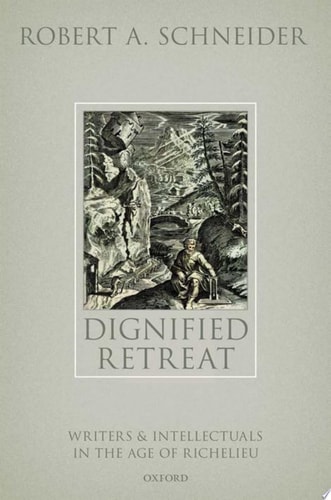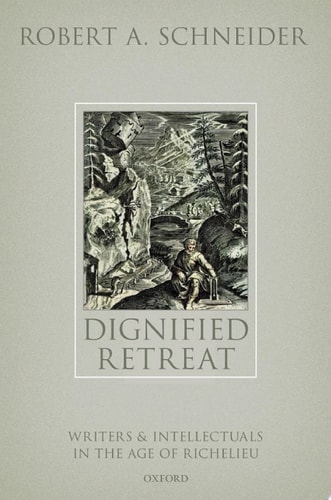
Dignified Retreat: Writers and Intellectuals in the Age of Richelieu
0
0
As an Amazon Associate and affiliate partner, Menrva Books earns from qualifying purchases. Learn more
Author Description
Dignified Retreat is a panoramic study of the vibrant literary and intellectual culture that emerged in early seventeenth-century France following the devastating Wars of Religion. This was a period that not only witnessed the recovery of the country following these wars, and the emergence of a strong, 'absolutist' monarchy under the Bourbons, but also the rise and refinement of the French language and the development of a literary culture that would soon be known as French classicism. Casting his net over a wide range of writers and intellectuals, Robert A. Schneider has assembled a roster of more than 100 men and women of letters, those constituting what he calls the 'generation of 1630'. While diverse, and indeed divided between those who hewed to traditional humanism and others more attuned to 'modern' linguistic and literary developments, this cohort largely shared a commitment to a cultural renewal of France, its rise to prominence in the geopolitical arena of Europe, and the emergence of a strong centralized monarchy. They depended on both the traditional aristocracy and the king's powerful minister, Cardinal Richelieu. But despite this dependency, these writers and intellectuals maintained a degree of independence and, more significantly, were the prime movers in crucial cultural developments that are too often identified with royal initiatives. For example, the author demonstrates that the Académie française, founded in 1635 by Richelieu, often considered formative in French cultural history, was actually more the result of the creative initiatives of these men of letters, which the savvy Cardinal only managed to co-opt and turn to the purposes of the crown.
Menrva's Summary
THE THESIS
This work investigates the extent to which the cultural and literary advancements of early seventeenth-century France were driven by independent intellectuals rather than solely by the state initiatives of Cardinal Richelieu. Robert A. Schneider, a historian specializing in early modern France, utilizes a prosopographical approach to analyze the 'generation of 1630.' By examining the lives and works of over 100 writers, he argues that these figures maintained significant agency while navigating the complex power dynamics between the traditional aristocracy and the emerging Bourbon monarchy.
THE SCOPE MAP
What You Will Find
- A prosopographical study of over 100 French writers and intellectuals active in the 1630s.
- An analysis of the transition from traditional humanism to early French classicism.
- A re-evaluation of the origins of the Académie française.
- Examination of the patronage systems involving the aristocracy and Cardinal Richelieu.
Scope Limits
- The study focuses primarily on the literary and intellectual cohort of the 1630s rather than a comprehensive political history of the entire century.
- It does not provide an exhaustive biography of every individual mentioned.
THE AUTHORITY PERSPECTIVE
Scholars recognize this text as a significant contribution to the understanding of cultural production under the Bourbon monarchy. Readers frequently note the author's ability to balance detailed prosopographical data with broader arguments regarding the autonomy of early modern intellectuals.
Page Count:
372
Publication Date:
2019-01-01
Publisher:
OUP Oxford
ISBN-10:
0192560824
ISBN-13:
9780192560827
History
Literary History
17th Century
French History
European History
Intellectual History