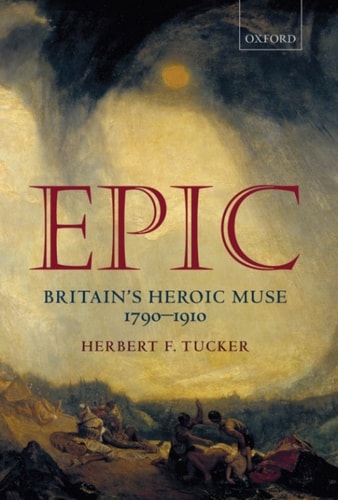
Epic: Britain's Heroic Muse 1790-1910
0
0
As an Amazon Associate and affiliate partner, Menrva Books earns from qualifying purchases. Learn more
Author Description
This book is the first to provide a connected history of epic poetry in Britain between the French Revolution and the First World War. Although epic is widely held to have been shouldered aside by the novel, if not invalidated in advance by modernity, in fact the genre was practised without interruption across the long nineteenth century by nearly every prominent Romantic and Victorian poet, and shoals of ambitious poetasters into the bargain. Poets kept the epic alive by revising its conventions to meet an overlapping series of changing realities: insurgent democracy, Napoleonic war, the rise of class consciousness and repeated reform of the franchise, challenges posed by scientific advance to religious belief and cherished notions of the human, the evolution of a postnationalist and eventually imperialist identity for Britain as the world's superpower. Each of these developments called on nineteenth-century epic to do what the genre had always done: affirm the unity of its sponsoring culture through a large utterance that both acknowledged the distinctive flowering of the modern and affirmed its rootedness in tradition. The best writers answered this call by figuring Britain's self-renewal and the genre's as versions of one another. In passing Herbert Tucker notices scores of mediocre congeners (and worse), so as to show where the challenge of a given decade fell and suggest what lay at stake. The background these lesser works provide throws into relief what the book stresses in extended discussions of several dozen major works: an unbroken history of daring experimentation in which circumspect, inventive, worried epoists engaged because the genre and the age alike demanded it.
Menrva's Summary
THE THESIS
This work investigates the evolution and persistence of the epic poetry genre in Britain from the French Revolution through the First World War. Herbert F. Tucker, a scholar of nineteenth-century literature, challenges the common assumption that the novel displaced epic poetry during this era. By analyzing a wide array of both prominent and lesser-known poets, he argues that the genre remained a vital, evolving medium used to negotiate the rapid social, political, and scientific shifts of the long nineteenth century.
THE SCOPE MAP
What You Will Find
- A comprehensive history of British epic poetry spanning 1790 to 1910.
- Analysis of how poets adapted classical epic conventions to address industrialization, imperialism, and democratic reform.
- Extended critical discussions of dozens of major poetic works alongside contextual references to minor poets.
Scope Limits
- The study focuses exclusively on British poetry and does not extend to epic traditions in other European nations or the Americas.
- It does not provide a general history of the novel or other prose forms of the period.
THE AUTHORITY PERSPECTIVE
Scholars recognize this text as a foundational study that reclaims the importance of the epic form in the nineteenth-century canon. Readers frequently note the academic density of the prose, which provides a rigorous examination of how poetic tradition intersected with the changing identity of the British state.
Page Count:
750
Publication Date:
2008-01-01
Publisher:
OUP Oxford
ISBN-10:
0191528404
ISBN-13:
9780191528408
Poetry
Romanticism
British History
English & College Success
English
Literary Criticism
Victorian
Criticism history
English poetry
Academic
Community Tags
Similar Books