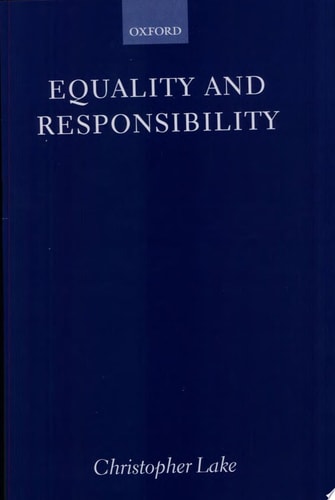
Equality and Responsibility
0
0
As an Amazon Associate and affiliate partner, Menrva Books earns from qualifying purchases. Learn more
Author Description
Arguments About Distributive Justice Often Take Place Around Two Ideas. One Is That Good Should Be Distributed Equally. The Other Is That How People Fare In Life Should Depend On What They Are Responsible For. The Author Asks What Draws Us To These Two Ideas And Examines Recent Attempts By Egalitarian Thinkers To Bring Them Together In A Single Distributive Ideal. Underlying This Ideal Is The Egalitarian Intuition - The Intuition That It Is Objectionable For Some To Be Worse Off Than Others Through No Fault Of Their Own. In A Wide-ranging Discussion, Lake Tests That Intuition From A Variety Of Perspectives And Points To The Gaps In Our Current Thinking About Quality And Individual Responsibility.
Menrva's Summary
THE THESIS
How can the competing principles of distributive equality and individual responsibility be reconciled within a single coherent framework of justice? Christopher Lake investigates the tension between the desire for equal distribution of goods and the belief that life outcomes should reflect personal responsibility. The author analyzes contemporary egalitarian theories that attempt to synthesize these concepts, focusing on the core intuition that inequality is only objectionable when it arises from factors beyond an individual's control. By evaluating these philosophical arguments, Lake identifies significant gaps in current academic discourse regarding the intersection of fairness and agency.
THE SCOPE MAP
What You Will Find
- An analysis of the egalitarian intuition regarding fault and misfortune
- A critical review of recent distributive justice theories
- A philosophical examination of the relationship between luck and personal choice
Scope Limits
- The text does not provide a comprehensive policy manual for government implementation
- The work focuses primarily on theoretical philosophy rather than empirical economic data
THE AUTHORITY PERSPECTIVE
Scholars and students of political philosophy frequently cite this work for its clear articulation of the tension between luck-egalitarianism and traditional equality. Readers often note the academic density of the prose, which is best suited for those already familiar with the foundational texts of distributive justice.
Page Count:
184
Publication Date:
2001-01-01
Publisher:
Oxford University Press, Incorporated
ISBN-10:
0191529214
ISBN-13:
9780191529214
Philosophy
Ethics
Distributive Justice
Responsibility
Social justice
Community Tags
Other Editions(3)

Similar Books