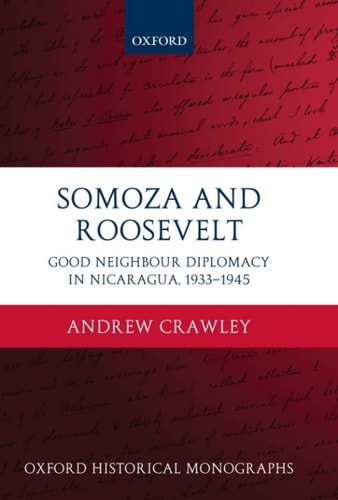
Somoza and Roosevelt: Good Neighbour Diplomacy in Nicaragua, 1933-1945
0
0
As an Amazon Associate and affiliate partner, Menrva Books earns from qualifying purchases. Learn more
Author Description
Franklin Roosevelt's good neighbour policy, coming in the wake of decades of US intervention in Central America, and following a lengthy US military occupation of Nicaragua, marked a significant shift in US policy towards Latin America. Its basic tenets were non-intervention and non-interference. The period was exceptionally significant for Nicaragua, as it witnessed the creation and consolidation of the Somoza government - one of Latin America's most enduring authoritarian regimes, which endured from 1936 to the sandinista revolution in 1979. Addressing the political, diplomatic, military, commercial, financial, and intelligence components of US policy, Andrew Crawley analyses the background to the US military withdrawal from Nicaragua in the early 1930s. He assesses the motivations for Washington's policy of disengagement from international affairs, and the creation of the Nicaraguan National Guard, as well as debating US accountability for what the Guard became under Somoza. Crawley effectively challenges the conventional theory that Somoza's regime was a creature of Washington. It was US non-intervention, not interference, he argues, that enhanced the prospects of tyranny.
Menrva's Summary
THE THESIS
This work investigates the complex relationship between the United States and Nicaragua during the implementation of the Good Neighbour policy, specifically questioning the extent of Washington's responsibility for the rise of the Somoza dictatorship. Andrew Crawley, an expert in diplomatic history, utilizes a comprehensive range of archival materials to examine the transition from direct military occupation to a policy of non-intervention. He argues that the shift toward disengagement, rather than active interference, inadvertently created the political vacuum that allowed the Somoza regime to consolidate power.
THE SCOPE MAP
What You Will Find
- Analysis of the US military withdrawal from Nicaragua in the early 1930s.
- Examination of the creation and evolution of the Nicaraguan National Guard.
- Evaluation of the political, diplomatic, military, commercial, and financial components of US-Nicaraguan relations.
- Debate regarding US accountability for the authoritarian trajectory of the Somoza government.
Scope Limits
- The study focuses primarily on the period between 1933 and 1945.
- The narrative does not provide a detailed history of the Sandinista revolution beyond its origins in the Somoza era.
THE AUTHORITY PERSPECTIVE
Scholars and historians frequently cite this monograph as a rigorous challenge to the traditional narrative that the Somoza regime was merely a puppet of Washington. The text is recognized for its dense, evidence-based approach to diplomatic history and its nuanced interpretation of non-interventionist foreign policy.
Page Count:
280
Publication Date:
2007-01-01
Publisher:
Oxford University Press
ISBN-10:
0191526525
ISBN-13:
9780191526527
History
20th Century
International relations
United States
American History
Diplomatic History
Community Tags
Similar Books