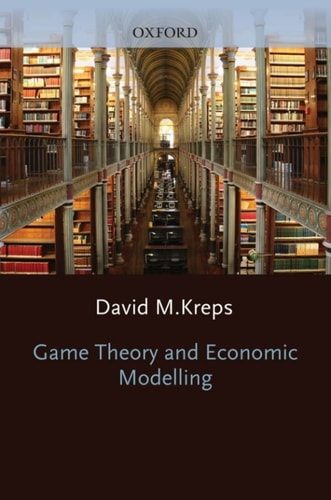
Game Theory and Economic Modelling
0
0
As an Amazon Associate and affiliate partner, Menrva Books earns from qualifying purchases. Learn more
Author Description
Over the past two decades, academic economics has undergone a mild revolution in methodology. The language, concepts and techniques of noncooperative game theory have become central to the discipline. This book provides the reader with some basic concepts from noncooperative theory, and then goes on to explore the strengths, weaknesses, and future of the theory as a tool of economic modelling and analysis. The central theses are that noncooperative game theory has been a remarkably popular tool in economics over the past decade because it allows analysts to capture essential features of dynamic competition and competition where some parties have proprietary information. The theory is weakest in providing a sense of when it - and equilibrium analysis in particular - can be applied and what to do when equilibrium analysis is inappropriate. Many of these weaknesses can be addressed by the consideration of individuals who are boundedly rational and learn imperfectly from the past. Written in a non-technical style and working by analogy, the book, first given as part of the Clarendon Lectures in Economics, is readily accessible to a broad audience and will be of interest to economists and students alike. Knowledge of game theory is not required as the concepts are developed as the book progresses.
Menrva's Summary
THE THESIS
This book investigates the utility and limitations of noncooperative game theory as a primary methodology for modern economic analysis. David M. Kreps, a prominent economist, utilizes his expertise to evaluate how game theory has shaped economic modeling over the last two decades. He argues that while the framework excels at capturing dynamic competition and information asymmetry, it faces significant challenges regarding its applicability and the necessity of incorporating bounded rationality.
THE SCOPE MAP
What You Will Find
- An introduction to fundamental concepts of noncooperative game theory
- Analysis of the strengths and weaknesses of equilibrium-based modeling
- Discussions on bounded rationality and imperfect learning
- Analogical explanations designed for non-technical accessibility
Scope Limits
- Does not provide a comprehensive mathematical manual for advanced game theory
- Does not cover cooperative game theory in depth
THE AUTHORITY PERSPECTIVE
Experts recognize this work as a foundational text for understanding the integration of game theory into economic discourse. Readers frequently note the clarity of the prose, which successfully translates complex theoretical concepts into accessible economic arguments.
Page Count:
208
Publication Date:
1990-01-01
Publisher:
Oxford University Press
ISBN-10:
0191521337
ISBN-13:
9780191521331
Economics
Mathematics - General
Mathematics Statistics
Game theory
Methodology
Academic